
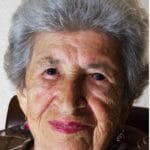
Ita Zeldovich, z"l (Belarus)
I was born in Belarus in the town of Parichi, not far from Bobruisk, on July 29, 1920. My father was a farmer. Before the 1917 revolution my father and his brother leased three acres of land because Jews weren’t allowed to own land. After the revolution, they owned the land. Each of them had six children. My older sister was born in 1912, and my baby brother was born in 1924. My mother tried very hard to ensure we all had a good education.
My father and uncle were forced to work on a collective farm in the 1930s. In those years it was very difficult to survive on a collective farm. We were blessed because we had our large house and garden already, and thanks to that garden we were able to survive.
My older sister married early, and another sister went to the Minsk Medical Institute. Because my parents couldn’t help her financially she had to work while she went to school. She graduated from Medical Institute in 1939. While in school, she married a student and they worked out of the same home where my parents lived. By then, my father had returned from the collective farm.
My brother started at Minsk Medical Institute two years after my sister. He loved to write, so he worked for the institute’s newspaper to make some money. As for me, when my father was still working I had to work on a collective farm, starting when I was eight years old. I was very envious of children who could go to Young Pioneer Camp, as we had to work during the summer. We harvested tomatoes and tobacco, the so-called children’s work, and had a quota that had to be met daily. We went to school in the winter.
After I graduated I also went to Minsk Medical Institute, so in my first year there my brother was in his third year and my sister in her fifth. My maiden name is Kitaychik, and when we were at school people would say, “there go the Chinese children.”
In 1941, when my brother was in his last year at the institute, the graduates told him they weren’t allowed to go home, that they were all going straight into the army. It was said war was not inevitable, but we felt something terrible was coming. Everyone was saying the same thing: we will fight on enemy territory, and we will not give up one single piece of land to the enemy. So we were confident that we were in no danger!
It just so happened that my father came to visit us in Minsk two days before the war began. My parents wanted to visit my brother because he was going into the army after graduation. My sister in Parichi had a baby by then, and both of my parents couldn’t leave her without help. They decided that my father would go first to see his son for a day or two, go home, and my mother would then visit. So it happened that, on the second day of my father’s visit, the announcement was made that war had started.
People were immediately banned from leaving the city in order to keep everyone from rushing to the train stations. War was declared on June 22, 1941, and the bombings began right away, though for the first two days it wasn’t so heavy.
At 11 o’clock on June 24, I went with my father and nephew (my older sister in Minsk lived with her husband and their seven-year old, who needed to go to school) to the center of the city. When we arrived I looked up and it was dark all around, as if birds had covered the sky. My father, nephew and I hid under an archway while the Germans bombed the city. The wounded were everywhere, and since we were so close to where my sister and brother-in-law worked that’s where we went. They were worried and called home to find out if their house was still standing, and whether anything had happened. We walked, as the trams weren’t running due to the rails being split. No one thought anything about us leaving.
We went home, but the bombing never stopped. The aircraft flew away and after two hours returned and bombed again. They flew low and strafed people as they ran. They taunted us. My father said he couldn’t do anything there, so he decided to walk home. I said to him, “Papa, I’ll go with you. I have one more test in pharmacology. I’ll hand it in this fall and continue my studies.” We didn’t realize what was coming. My sister asked us to take my nephew Mark with us, thinking the Germans wouldn’t bomb where my parents lived. She and her husband would go to work the next day. At that time you weren’t allowed to miss work, and even if you were five minutes late you could be put on trial. Back then it was very strict.
We wondered what we should take with us, which I remember like it happened just yesterday: we took bread, biscuits, water, and pulled a blanket from the bed to have something to sit on in the woods. Then we left. My sister told her husband they should walk with us to make sure we got out of the city and spend the night in the woods before returning.
We found out everyone was trying to leave Minsk and that no one should consider going to work the following day. There were many people traveling in cars and such. My brother-in-law said he wanted to go back to get a few things, since all we had were our papers. I had my passport because I could be stopped and asked who I was, and my Komsomol membership card because I had to carry it at all times. I left everything else in the dormitory, including my grade book. We persuaded my brother-in-law not to go back, since we would find everything we needed at home (clothes and other things). I don’t know what would have happened to us if he had gone back.
After three days walking we were almost at Bobruisk, 50 kilometers from our home. We sometimes carried my nephew on our shoulders, and because we had nothing else it was easy to do. When we arrived in Bobruisk everything was destroyed, so we figured the Germans were already in the city. We crossed the Berezina River in a small boat and aimlessly ran away from the explosions. We were certain the Germans were there and that we couldn’t go home, so we went the other way. Sometimes at night we were invited to stay in people’s homes. Several people wouldn’t allow us in, because they were afraid that we would rob them. Several shouted at us: “There go the running Jews.”
I remember that we went to Bykhov and stayed the night. People there seemed calm and quiet, as if nothing was happening. My brother-in-law was in the reserves, and tried register at every military post along the way. He went to the post at Bykhov too, where they asked him to help with their payroll since his specialty was in finance. So he helped them. They also asked who he was with, and he told them about us. They couldn’t let him in the army because they couldn’t certify he’d graduated the institute, and he couldn’t enlist because there wasn’t time. They told him to take us out of the city, because the bridge over the Dnepr River was to be blown up in two hours and there wouldn’t be any way to leave. Once again, we walked.
We reach Krichev Train Station in ten days, and couldn’t walk anymore. There was space available on a train with open-air wagons, so we took it. A train finally left and took us to an evacuation center, where we were told we’d have to help with the harvest. Someone took us to a village, though I can’t remember exactly where it was. It seems to me it was not far from Rostov-on-Don. We worked 10 days in the fields, morning to night, and received some bread and milk to live on. My sister found an organization and asked whether there was other work we could do. There was nothing, so we stayed.
Time passed and winter came, though we still had nothing. Our clothes were in tatters by then. A woman there looked at my sister’s passport picture and wept because the photograph seemed like a completely different person (we had changed so much during those few weeks). The woman said nobody was going to detain us, and we could leave if we wanted. We decided to move on, and went to the regional center, where the trains were. With no money for tickets, we managed to sell my brother-in-law’s watch and bought tickets to the nearest station. We rode on a mail train headed for Moscow with soldiers on board, who fed us.
We weren’t able to get in touch with our family, and sent letters that in all probability never made it. We didn’t know a thing regarding them. Our tickets were only good to Voronezh, so we got off there. Again, my brother-in-law went to the Army recruitment center, and again he wasn’t allowed to go into the army. He was sent to work as a city auditor in Ostrogorsk, in the Voronezh region. They gave him money to move the entire family, so we all went to Ostrogorsk. By chance, we ran into a relative on the train who told us my brother had been killed on August 5, 1941, near Velikie Luki in the Kalinin region. He’d received his diploma and gone to Moscow with the other young men, where they were formed up as a medical team on a train. My father had thought my brother would survive because he was a doctor and wouldn’t have to carry a rifle.
My passport showed I’d lived in the medical institute dormitory since 1938, and my Komsomol membership card proved I’d paid my dues as a student for three years. This proved I was a medical student. I was sent to work as a nurse in an orphanage for emotionally disabled children. At the orphanage I received shoes, underwear, and three meters of fabric so I could sew a dress, as my only dress was tattered. My sister and I sewed the dress by hand. She stayed home, and we bought some cloth and wool and made a large blanket for covers. People were selling things left by soldiers, which we bought at very low prices. We made socks from sweater sleeves to keep our feet warm.
We were in Ostrogorsk for about three months. Some of the workers at my brother-in-law’s office had joined partisan units, which we wanted to do as well. But they told him he had to take his family away, so we went to the station to evacuate. We wanted to go to Tashkent, since it was warm there. A train arrived with boxcars to take us somewhere, but no one knew where it was going. Our family was large, so we needed a train with room enough for us all. When one arrived, we boarded.
There were Volga Germans on the train from Engels. They were afraid to leave (and afraid they’d be asked to help the Germans), but had decided to evacuate. They were given only 24 hours to prepare for the trip. They had food, but we had nothing. I remember the train stopping somewhere on the steppe, but not at the stations. There were sugar beets in the fields that hadn’t been harvested, which we cooked and ate. I don’t remember how long we were on the train.
We didn’t know where the train was going, but it finally arrived in Karaganda, where we got off while the Volga Germans kept going. They were being taken to Kazakhstan. My brother-in-law went to the military to prove he wasn’t a deserter, who told him the same thing he’d been told every other time. He was sent to Balkhash, Kazakhstan to be an auditor, and they provided tickets for all of us. I believe there is a G-d, for without him we would have perished.
We met up in Balkhash and were given a room in a barracks. Someone came from my brother-in-law’s workplace to check how we were doing, so we showed him the room. “Where are your things?” he asked, so we showed him our bundle made from the blanket. They brought in metal beds for each of us, mattresses, blankets, and everything else. We were very happy. My nephew didn’t go to school because he had nothing to wear, and so he missed a lot. My father also stayed home. My sister found work and I worked as a nurse in a hospital not far away. In the winter I literally ran to work, as I didn’t have warm clothing. The hospital was short of workers so I sometimes worked 24 or 36 hours straight. I worked there for approximately two years.
I saw an announcement in a newspaper that the Belarussian Medical Institute had begun operating again, but in Yaroslavl, Russia. I wrote and explained that I only had my passport and Komsomol membership card, but not my grade book, and could they possibly invite me to study. At that time, people couldn’t go anywhere without an approved invitation. They wrote back and told me to wait for the invitation. I was working night shifts on the children’s typhoid ward.
The institute’s invitation arrived and I left. On the train, people were talking about how and where Jews were being killed. I had left my mother, sister, her husband and child, and my little brother, and I cried all the way. I had to transfer trains in Moscow, but felt like I had a fever. I decided not to go to a clinic thinking they’d have to quarantine me; I just had to get to Yaroslavl.
When I arrived they gave me a dormitory room. I took a shower with the door open, because I thought I might fall and lose consciousness. Back in my room I lay down, but I couldn’t get back up. The next day a professor came and I told him I’d been in contact with typhoid patients, so I was put in a hospital for maybe a month or more. Once I was released I continued my studies.
By that time Belarus had been liberated, and the Soviet Army was in the Vitebsk region, where partisan units had previously been. They had an outbreak of typhus and were concerned the soldiers were contagious. Someone decided to send students from our institute to Belarus in the winter, after classes were over, to fight the typhus outbreak. They told me to stay behind since I’d been awfully sick not long before. But I didn’t want to stay and went with the rest. We were in Moscow for two weeks, where we were vaccinated against all types of diseases and issued shirts, shoes, and socks before we left for Belarus.
Everything we saw along the way was so frightening: there were chimneys, but nothing else. The city of Nevil was completely destroyed and devoid of people. The only thing we saw on the streets there was a single cat, and nothing else.
We were taken to different villages, even though the Germans were all around. Another girl and I were in a village where the Germans were just three kilometers away. As we went from one village to another we came under artillery fire, and when we walked through the woods we could hear the bullets whistling all around. But we had to go, so we went. Only one girl from our group became sick. She recovered there and returned with us to Yaroslavl. We were in Belarus for around three or four weeks, then returned to Yaroslavl to continue our studies.
Prior to the war, during class, we didn’t think about food, but now we were constantly hungry. I told my girlfriend that when the school year began we didn’t eat just because there wasn’t time. But we wanted to eat! In my fifth year at the institute I went to Balkhash to see my father and sister during summer holiday. I was persuaded to stay, to work at the hospital as a doctor because they didn’t have enough medical personnel. They told me I could return to finish at the institute when the war ended, so I was in Balkhash on May 9, 1945, Victory Day. I returned to Minsk after that to finish medical school, which I did in 1946. Just before I graduated I married a disabled veteran, and we remained in Minsk, Belarus.
Later on, I found out what had happened to our relatives. After the war began, they’d loaded their things on a cart pulled by a horse and got about ten kilometers away when they were told the Germans had left. They went back to their home. But the Germans came back and took my mother, my sister’s husband, their baby and others, and forced them to dig a pit. Then the Germans stood them at the edge of the pit and shot them. They forced my sister to work as a doctor, then killed her. My brother told us our sister’s last words were: “Bastards. I treated you, and you are going to kill me.” She was killed by the local police. We still don’t know where she was buried. She was not quite thirty years old.
My other sister and her husband returned to Minsk after the war, but their house had been destroyed and there was nowhere to live. Friends in Kazan asked them to go there, so they left with my father. My husband and I stayed in Minsk, and another brother came to live with us to study.
People in the country were nervous, saying another war could begin. When my sister invited us to Kazan we moved there. My husband worked in a secret position in an optical-mechanical plant, so we weren’t allowed to leave the country for several years. When we applied to emigrate, in 1979, both of us were immediately fired. Our request was denied until 1991, after the coup on 23 August. At that point we didn’t know what would happen to us; we even thought we might be sent to Siberia. The coup didn’t work, and we received an unexpected telephone call from the OVIR telling us to come and get our passports. We got our tickets that same day, and arrived in America on September 11, 1991.