
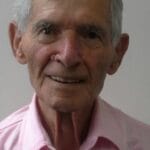
James Lieber, z"l (Hungary)
I was born on August 19, 1928, in the town of Mezőkövesd, Hungary, where I was raised as well. My name was Imre until I got to this country, where it was changed. My dad’s name was Belo Lieber, and my mother’s name was Leonora Lieber. Four of my brothers survived the war with me, but I lost two brothers at the front when Hungary fought the Germans and Russians. They were killed on the front in either 1941 or 1942, I can’t recall now.
My birthday was actually also changed when I came to this country. I had a black spot on one of my lungs, and the counsel who gave out visas to the United States wanted to make me and my middle brother teenaged twins so he could send us without having to wait. Visas were issued according to country population, and Hungary only had eight million, unlike France and Italy with fifty or sixty million. But if you were a teenager they could give you a visa right away. My older brother Mike had to wait an extra four years to come to this country.
In early spring of 1943 they took me and my family from our small town, Mezőkövesd, to Miskolc, Hungary, a bigger city that had a ghetto. We were there approximately three weeks until a train came, and then they loaded us into boxcars with no seats. I had two grandmothers there, and they couldn’t sit down. We had to stand and had nothing whatsoever, not even water, until we arrived at Auschwitz.
When we got off the train at Auschwitz, they made my father, mother, and younger brother go to the left, as I remember. Doctor Mengele made my older sister and I go to the right. I don’t remember how long we stayed at Auschwitz, maybe a couple of weeks. I learned that my parents and younger brother were told they were going to take a shower, though no water came out, just gas. The gas killed them. For the next day or two you could smell the burning meat and flesh, human natures being burned. I wouldn’t wish that experience on anyone. A few weeks after that, they moved me from Auschwitz to Mauthausen.
Mauthausen was even worse as a concentration camp than Auschwitz, though it didn’t have a gas chamber. They treated us worse than in Auschwitz, though thank G-d I only stayed there about two or three weeks. I didn’t work at Mauthausen; they made me do certain things, but nobody worked there. That place was strictly used for people from Auschwitz being shifted to work camps.
I was transferred to Melk, Austria, where they had a big factory in the Alps. They were digging a tunnel there, bigger and bigger, and I became a spitzen trager, which meant my job was to take cutting tools outside to sharpen them and return them so they could cut the bricks and wood, whatever was used in the tunnel, all day long, back and forth. They used wood in the tunnel to hold the ceilings and walls up, so we sharpened the tools outside because sparks would fly and they didn’t want fires in the tunnel. I worked at Melk from 1943 to about March or April of 1945.
A German guard brought me bread every day. If they had seen him do this they would have shot him. We saw a Nazi hung once, but didn’t know what he’d done. I don’t know why this guard brought me bread; maybe it was because I spoke to him in Yiddish and he could understand my “German.” Yiddish and German are alike. It could have been because he’d seen me at the back of a line and picked me out for whatever reason to help. I told him I was sharing with two other young fellows like myself. Sometimes he brought me a half a loaf of bread, and I told him, “The more bread you bring, the more I’m going to share it with other people.” They did feed us some food to make sure we were able to complete our work for the day. All this was when I was either 15- or 16-years old.
I was capable of doing the work, although the tools were about 30 to 50 pounds, maybe more sometimes. They took any tool that had gone dull from the tunnel right away. They didn’t wait, because if there were too many to sharpen they could run out of tools. They only had a certain amount of tools, maybe ten, so if one got dull they took it out to be sharpened again.
In March or April 1945, they transferred us out of Melk. We started walking towards Ebensee, about 60 or 70 kilometers away. I guess Hitler was still figuring they could develop the atomic bomb so they wouldn’t lose the war. They moved us because the Russians were coming from that direction.
In either May or June a unit of black Americans liberated us at Ebensee. That morning, when we woke up, we didn’t see any German guards in the camp. When I saw the Americans I thought maybe all Americans were black. Four of us, all around my age, went to where the German guards had been and picked up rifles and pistols. We decided that if we saw Nazis we were going to kill them. Someone shot a man at Ebensee and I said, “You shouldn’t shoot him because you don’t know what he did. He might be an innocent person.” I left those guys; I didn’t want to stay with them.
I was looking for freight trains to get back to Hungary to see who was left in my family, because there were no regular trains at that time. It took many days to get back to Hungary, to my small town, which was on a small rail line between Budapest and Prague. So when we got to Mezőkövesd I just jumped off the train.
I reunited with my older brother Mike, my middle brother Joe, and my sister and her new husband, who she met either in the camp or afterwards. They got married in Prague, Czechoslovakia, and they came home.
There were people living in our home and in both of my grandmothers’ homes. I don’t remember which, but we took back one of the two homes, but only stayed for a little while there before we left. We didn’t want to be there any longer because of things like this: one day I went to visit a neighbor, a doctor, and could see that the ground was all broken up where people were digging to see if others had buried their money, jewelry, or whatever. I didn’t blame Hungarians for anything until I saw this. I said, “If these are the kind of people we have here, we don’t need to stay here in this country anymore.”
We took a train to a small town in Austria and walked across the Alps into Italy. We walked all the way to a city near the mountains, though I don’t remember which city. From there we took a train to Rome, Italy. There was sort of a camp there where people like us went and applied for visas. They gave us living quarters and also fed us. Although we applied for work, after World War II there were no jobs there, even for the Italians. We stayed in Cinecittà, then applied for visas to come to America.
I left Naples, Italy, in December 1946, and arrived in New York in January 1947. From there we went to Detroit, Michigan, where we had family. We stayed in a Jewish community in New York for a few days, where they put us up and fed us. When I say “we” I mean my two brothers and me. My older brother, Mike, is still alive. My middle brother, who became my “twin,” has passed on. We had two uncles in Detroit, which is why my brothers and I came to this country. My sister’s husband had relatives in Israel, so they went there. She passed away about six or seven years ago. She was ninety-three years old.
I was drafted in the U.S. Army during the Korean War and sent to artillery school. After I finished basic training, my company commander decided I shouldn’t have to go to Korea because I’d seen enough killing in my life. Instead, they sent me to Mauthausen, Germany, the same place I’d been held by the Nazis.
After the Army I returned to Detroit, Michigan. My older brother Mike worked in a hotel as a chef with Italian and French chefs, and he became a pretty good chef. I told my uncle in Detroit: “It’s so cold here in the winter. Where do they grow oranges in this country?” He said, “California, and fellows like you would go to Los Angeles.” I got enough money from when I got out of the military and bought a 1947 Buick, or a Chevrolet, and I went to Los Angeles with my two brothers, Mike and Joe. I told my older brother, “You’re a good chef, and we have enough money. Maybe we can open a Hungarian restaurant?”
Two whole blocks in Los Angeles had Jewish delicatessens, Italian restaurants, and Chinese restaurants, just restaurants on both blocks. Our restaurant was small, maybe about 50 seats plus the kitchen, but after two or three months people liked our food so much that they were waiting outside to get in. There was a table next to the door, so we didn’t even have enough room to wait inside.
I met my wife in Los Angeles, and I wanted to have children. But I didn’t want to bring any into this world after what I’d seen.