
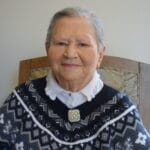
Luiza Perchik, z"l (Ukraine)
I was born in 1928 in Odessa. It is a port city in Ukraine, located right on the Black Sea. There were five of us in my family: my father, mother, me and my two sisters, Zina and Dora. I was the youngest. My mother, Yevgeniya Gelfenbein, was a housewife. My father, Rudolf-Ruvim Perchik, worked for the government. He supplied Odessa with wood to build houses.
In June 1941, when the war started, I had finished five grades and was only 13 years old. I remember how people would get together just to support each other, just to exchange a few words. We did not have bomb shelters, and when the bombs fell we had no place to hide. A few days after the war began, the evacuation started.
Men stayed to protect the city, and women with children were sent to the north. My father was part of civil defense. My mother, my two sisters and I, along with my mother’s sister and her daughter, took our documents and left for Peresyp, a region of Odessa, leaving behind our home with all our belongings. We were put in railway boxcars used for transporting animals and sent deep into the country. The boxcars were packed and had no facilities, no water, and no food. People were suffering from the heat, and the children were crying. But we knew that eventually we would get away from the bombing to a place where we would be safe. That is what gave us hope and kept us going. We were leaving Odessa hoping that we would be back soon, but it was an illusion. We suffered for four and a half years, moving from place to place.
The train moved slowly, and the bombing continued. When we stopped at Razdelnaya Station, my aunt Liza and my oldest sister Zina got off the train to get some water. They thought that it was a long stop, and that they would have enough time to get water and return to the train. Suddenly, bombs began to fall, and the train started to move, faster and faster, to escape the bombing. We were taken away on that train, leaving my aunt and my sister behind. Children were screaming, people were panicking – it was chaos.
My mother, my sister Dora, my cousin Zoya, and I arrived in Kazan. Just a few kilometers away was the small village of Zeleniy Dol, where a friend of my father’s lived. His last name was Anokhin; I don’t remember his first name. Anokhin welcomed us like family, and we stayed with him and his family for two months until we finally reunited with my Aunt Liza and my sister Zina. Prior to our trip, we had decided that if something happened to any of us, we should meet here, at Anokhin’s.
Winter was coming. We had neither appropriate clothes nor shoes. The Germans were moving into the depths of the country. We had heard that the Germans would exterminate Jews first, and we made a decision to start moving farther. We got to Alma-Ata, Kazakhstan, and stayed there for some time. The village where we stayed was very small, and the locals did not speak Russian. This place was also quite dangerous for young women, so we moved farther toward Barnaul, Russia. With lots of difficulties on the way, practically without water, food, and clothes, and without means of transportation, we got to a station called Pesyanka, in the Troitskiy district of the Altay region, close to Barnaul.
We lived there for three years without knowing about my father and other relatives. Locals gave us a small piece of land and a little house. I was fourteen years old and worked for twelve hours each night at the wood factory, which supplied the army with ammunition. During the day I went to school. We had no food. We planted potatoes – that is all we had to eat.
When my father returned, we moved to Novosibirsk, Russia, where I finished the 9th grade. We decided to go back to Odessa once the city was liberated. Returning was also very difficult, but we made it. When we arrived, we found that our apartment was occupied by other people. Our belongings had disappeared too. After having many battles with different government departments, we got our apartment back except for one room. They simply took it away from us without any explanation.
Life in Odessa was very hard. We had no water and no electricity. I was in the 10th grade and did my homework in the dark using a candle. To get water we had to walk to a well that was far away. It was all very difficult, but at the same time we were happy that the war was over and we were alive!
I should have finished high school with a gold medal as a reward for being the top student, but the reward went to a different student. The girl who received the medal instead of me was of Russian nationality, and I was Jewish. This was my first encounter with anti-Semitism. However, I got into Odessa State University and graduated as the top student. I studied Russian language and literature. My father dreamed about his daughters getting the best education, and we did! Despite the fact that it was very hard for Jewish people to get into a school, both of my sisters became doctors, and I graduated from the university.
It was also a struggle to find a job after school if you were Jewish. Everybody else would get a job quickly and easily, but for Jewish people it was a real problem. I finally got a job as a Russian language and literature teacher at a school. Part of my responsibilities involved reporting on teachers who attended religious institutions, church or synagogue. Going to a church or a synagogue was very risky and dangerous. Those who attended services could be fired.
I got married in 1951 and moved to Baku, Azerbaijan. My husband had a job there at a shipyard.[1] Our daughter Galina was born in 1953, and our son Rudolf was born in 1962.
My husband’s brother and his family immigrated to Israel, and though he was a talented engineer this caused all sorts of problems at work for my husband. After my daughter and her family immigrated to the United States in 1989, we decided to follow them. We wanted to live in a country where people have a much better life, where the elderly have financial security and can enjoy life. In the country where I was born, there was none of that; we could not trust the system, and we had no financial or moral stability. My children found good jobs in America, and our oldest grandson became an anesthesiologist. My husband and I are very proud of him. Our youngest grandson is a hard-working man. He has a big family and is a provider. I am proud of the fact that I have been living in America for so many years, and every morning I get up and say, “G-d bless America! The country of great opportunities! G-d bless America! My home, my land!”
[1] Ms. Perchik’s husband was William Bukhman, whose account of the Holocaust can be found in Volume I of To Tell Our Stories.