
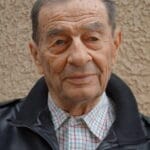
Mark Veksler, z"l (Ukraine)
I am Mark Veksler, originally from Kiev, Ukraine. In mid-June 1941, I had gone alone to stay with the family of my father’s friend, Ivan Shkurpello. In those days they lived in a small village called Sitkovets, in Ukraine’s Vinnitsa Region. Ivan’s children and I spent our time together in light-hearted ways. We fished, gathered mushrooms, all those sorts of things you do when you’re young. I was 12 years old at the time.
We celebrated my birthday on June 24, 1941, not realizing that the war had already started. In the village we learned of the war on either June 25 or 26.
By then the German Army had already taken almost all of western Ukraine. Vinnitsa was the railway hub I had to use to return to my family in Kiev, but Vinnitsa was practically surrounded by then. Kiev was 350 kilometers from where I was, but the problem was not one of distance, it was that German troops were almost everywhere. Airborne troops had parachuted in, and even German regular army soldiers were all over. They’d completely destroyed many of the rail lines, and there was hardly any leadership in the area. In short, it was chaos.
To this day I can’t understand how it was my carefree life came to such a sudden ending. In front of me would be many serious tests.
I wanted to return to our home, though Ivan asked me to stay there. He said it would save me, and that I could live with him as a son. However, I insisted on leaving and asked for his help. He gave me enough food for four or five days and a little money before putting me on a night train that departed for Vinnitsa (I don’t remember which station I left from). This was either June 28 or 29, 1941.
The train I wound up on was filled with criminals. They had been released from prison due to the lack of a functioning government. And, of course, they were starving. Seeing that I had a suitcase full of food, they opened it right there and ate everything I had. I was left without any food and without any way to purchase more.
The train moved slowly, but it made it to Nemirov Station where we were told that we couldn’t go any farther. Everything had been bombed. I still needed to get to Vinnitsa, which was still at least 80 to 100 kilometers away. I stayed on the train that night, and in the morning I climbed into an open boxcar on a train that made it to Vinnitsa that night. I don’t recall whether I ate anything that day, but I do remember that I was very hungry.
The Vinnitsa Railroad Station had been bombed. Rail cars sat on the tracks with people inside, though I don’t know what they were waiting for. I also saw military troops, mainly infantrymen, unloading from cars. On a nearby rail apron, I saw a train car with policemen on it. One of the police officers called me over and asked why I was crying, but I didn’t answer. When he asked if it was because I was hungry, I cried out that I was. He took some white bread from his bag and gave me a large hunk. I ate it and washed it down with water.
The police put me in their car and told me they were going to Kiev. I traveled with them all night, a night that was cold despite the fact that it was summer. In actuality, we traveled for an hour and stayed put for two because of the bombing. By morning I was on another train at Kazatin (another name Koziatyn) Station, still in Vinnitsa region. This time there weren’t any policemen, only peasants. I was very hungry and an older woman offered me a piece of Ukrainian bread. It seemed very tasty to me.
I continued to move toward Kiev: sometimes in train cars and sometimes walking along the rails. Everything around me was in confusion. The majority of people were walking and riding along the rails or on the roads. German airplanes bombed along the way during the day and at night about every two or three hours. As soon the German planes showed up, the trains would stop. The people would scatter out and lie under the rail cars and in the fields. When the airplanes flew off, people would return to the trains. Some people got wounded. Some didn’t return, the bullets taking them during the attacks. They died and no one picked up their bodies. I got lucky: one bullet just missed me.
This went on for three days. When I was near Fastov, about 50 kilometers from Kiev, I ran into a friend (whose name, unfortunately, I can’t now recall). He was older than me and more experienced, and he helped me keep my head down. He taught me that I needed to run into the fields, the grass, and go in all directions. One morning, after one of the many bombings, I stood up and called out for my friend but he didn’t answer. I went to find him, but he had been killed. This was the first time I had met with death. I couldn’t lift him, so I sat down and cried. I left him there, on the ground, and once again headed in the direction of Kiev.
I was still at the station in Fastov early in the morning when I saw an electric train headed to Kiev. I was hungry and tired, but I was fortunate as well: this was an actual rail car with people and tickets. Of course, I didn’t have a ticket and I had no money. But I got in anyway. I figured I might get to Kiev in an hour and a half or so. But that wasn’t to be. They first bombed us at Vasilkov, and again at Pivnye. These are two stations on the way to Kiev. I finally made it to Kiev Station, and arrived home 30 minutes after that. You can imagine just how joyful and tearful that meeting was! My family had assumed that I had been killed and yet there I was, whole but hungry. The first thing I asked to do was to eat.
The bombing had begun in Kiev on June 22, 1941. Some of the people in the city had already left, and many others were preparing to evacuate. They were taking equipment to the train platforms for evacuation as well. Each day on the radio there would be an announcement that those who desired to leave could do so. People were fleeing to the east, though no one knew exactly where. My family – that is, me, my grandfather, my mother, her sister (who had a daughter), and my brother Misha – climbed into an open boxcar that was headed east. My father had been called up to the Red Army, so the leader of our family was my grandfather.
Our train had to cross the Dnepr River, but the Germans controlled the area and bombed the bridge day and night. We got lucky and made it across the train bridge. This was at the end of August, 1941. After several days we pulled into the city of Salsk, in the Rostov Region, without having stopped. We were fed there, and then loaded onto horse-drawn carts that took us to a Kolkhoz about 25 kilometers away.[1] We worked on the Kolkhoz for about a month, maybe a little more. The front lines were quickly moving to the east, and the threat that the Germans would soon be in Rostov and that area was real.
Our grandfather decided we had to get out and to go to his daughter who lived in Cheboksary in the Chuvashia Autonomous Republic. We went first to Rostov, then to Stalingrad, and then we took a boat to Cheboksary. We didn’t stay for very long, however, as the Germans were now approaching Moscow and they were bombing Cheboksary. In late fall, we prepared to leave again, this time for central Asia. When we departed, we were headed for Tashkent, Uzbekistan.
In Tashkent, my mother couldn’t find work and there was very little to eat. We had no money, and there was no government help. I did go to school, where they fed me a weak soup that was practically just water. Eventually, they gave us some potatoes and bread, which made things a little better. But we weren’t there long, and soon left for Dzhambul, Kazakhstan.
In Dzhambul we worked on a Kolkhoz, and we also had a cow. I would bring her things to eat like grass, leaves, beet roots, and cornstalks. Not long after that our father showed up. He was wounded at Poltava when it was surrounded, and was sent to the rear. Once he found us, he began working at the Kolkhoz as well. We lived five or six kilometers away from where we worked, so my father and I walked there each day.
After a little time passed my father, mother, younger brother and I went to Tashkent, where my father found work as a baker in a bread factory. Life became easier. As a baker he was allowed to eat as much bread as he wanted at work. We had ration cards for bread (300 to 400 grams of bread per person per day). I continued to go to school and entered a preparatory school at the Central Asian Polytechnical Institute in 1944.
In 1945, after we celebrated our victory over the Germans on May 9, my family prepared to return to Kiev. I returned in September, 1945, when I was 16 years old. I entered the Kiev Polytechnical Institute and received my diploma in Mechanical Engineering in 1951. Following that I was assigned to Nizhny Tagil, Russia, where I worked as a shift supervisor at an oxygen factory. Over the years I worked in various concerns all across the Soviet Union. From 1988 to 1993 I was Undersecretary of Ukraine’s Iron Production Ministry. From 1993 to 1996 I was the Ukrainian Regional Manager for the German company, Liftec-Linde.
I immigrated to the United States with my wife in 1996, to Tucson, Arizona, where my son and his family were living. I volunteered at MER Corporation, a company that stored hydrogen for new automobiles that use hydrogen as a fuel.
I have a United States patent for an invention in this field. I defended my Ph.D. dissertation in Moscow and was awarded the rank of Candidate of Technical Sciences. I established this standing when I came to the United States.
[1] A Kolkhoz was a collective farm in the Soviet Union.