
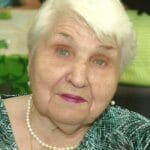
Maryasha Zlobinska, z"l (Ukraine)
I was born Maryasha Wiseman on January 19, 1922, in Chernobyl, Ukraine. Our family lived there until 1924, when we moved to Kiev. My family consisted of my mother, who was a housewife, and my father, a factory director. His factory manufactured suede gloves, coats, and cloth covers. There were two children in the family: me and my little sister, who was born in 1927. I had 17 uncles and aunts and 19 cousins.
Except for my father, my family was very religious. My grandfather and grandmother celebrated every Jewish holiday. Our grandfather, who lived with us, prayed and celebrated all of the holidays in another room so that no one could see. My father was a communist party member so it wasn’t safe for him to have a believer in the house, especially a Jew. But my father respected my grandfather. On holidays (such as Passover), there were separate dishes for my grandfather and no one brought bread to him in his prayer room.
Until the war I worked as a bookkeeper. I married in 1939, and on October 27, 1940, our daughter Esfir was born. The first I heard of the war was when my father came home to tell us. He was born in 1888, and he was disabled during World War I. In 1941, when the war began, he was a deputy in the city council, and in the morning was called to communist headquarters and then to city hall. I was truly shocked. My husband, who was in the army and in western Ukraine training for two months, wound up in the war there.
Instead of evacuating, we waited for my husband to return, but he received orders to go the other way. We finally left, as the Germans had occupied one area of the city already. My husband wrote letters telling us we should leave, because the Germans were like animals. There was no other way out. I left on foot with my mother, little sister and my tiny baby (Esfir was only ten months old) and with other retreating people and forces.
It was terrible to travel at night. We were hungry and not well-clothed. What could we have taken with us? We all went hungry. What would we feed the baby? I couldn’t always get food for her. At night I would risk my life by knocking on peasants’ doors. Some gave, and others showed up with sticks in their hands. Sometimes we picked things up that we found on the ground, but there was no way to heat water. We walked and were afraid of everyone and everything. My baby grew sick from cold and hunger. She had a very high fever and her little legs were paralyzed. But thank G-d we were able to get past the front.
On November 11, 1941, we made it to Novokhopersk, in the Voronezh region of Russia. We were barefoot, sick, and infested with lice. The locals there met us with open arms: they washed us, clothed us, and fed us. Before the war, all Komsomol members were required to learn a specialty just in case. I had completed a nursing course in the reserves, and in Novokhopersk I worked in an army hospital.
The war continued, and families with children in the Voronezh region were sent to the rear. We wound up in Akmolinsk, Kazakhstan. I worked in the Petrovsky plant there (manned by evacuees), where we made weapons for the war. I went to the military commission in Akmolinsk to ask them to search for my husband. In December 1942, I was called to the commission and was given his death notice. I requested to go to the front. My mother was still young and my sister was growing; I decided to leave my daughter with them.
That month, I entered the army and was sent to attend an accelerated course of study at a military school. From there, with the rank of a military medical assistant, I wound up at the front lines. I served in a mobile train unit: three passenger cars, a kitchen, living quarters for service personnel, and 22 freight cars. The train crew included a director (a military doctor), a deputy medical assistant (me), political officer, senior sergeant, five nurses, two cooks, and 22 nursing assistants. We picked up the wounded at the front and took them to a sorting area, and from there to an ambulance train. I was the only Jew in our group, which included Tatars, Uzbekis, Kazakhis, and Russians. Their attitude toward me was good; after all, I was a widow and I had a baby. The nursing assistants were family men, and they weren’t young either.
I was demobilized in January 1946 after an order regarding women in the army with children up to five years old was issued. I went to Kiev, where my family had returned. I found them in a very frightful situation, as they were impoverished. Eleven men in our family had died while I was at the front, and five more were lying in Babi Yar. Three of those were children. Three of us, two of my cousins and I, returned home from the war. All three of us were born in 1922. One of the cousins lived in Israel (he has since passed away), and the second lives in Chicago.
What does it mean for me to be Jewish? It means proving that I am a hard worker at all times, that I am dedicated. When I was a child, despite the fact my father was a member of the communist party, I endured such humiliation. I don’t know if this was only in Kiev. At that time, Skrypnyk was Minister of Education. There were German, Polish, Russian, Ukrainian and Jewish schools, and Skrypnyk ordered that everyone would be required to attend school based on nationality. If you wanted to switch to a different school you had to prove you didn’t know the language in the first one. My cousin and I took examinations. I kept quiet while my cousin answered the questions. So my cousin went to a Jewish school, and I was transferred to a Ukrainian school. I wasn’t allowed to attend the Russian school. At home we spoke Yiddish, though on the street I heard a mix of Russian and Ukrainian. We spoke Ukrainian in school.
After the war I worked as head nurse in a hospital. I married a second time, and my husband was transferred to Lvov, so I left with him. In Lvov I was a surgical nurse and a head nurse. I labored untiringly my entire life and took control of my work, because those years were difficult. In Lvov, I found out that there were followers of Bandera moving about, and my husband – a member of the communist party – was often sent to nearby villages and towns to try to enlist people into buying bonds. Followers of Bandera watched for people in the forests and would rob and kill them. I lived in Lvov for five-and-a-half years. We moved back to Kiev, where I worked for 28 years in medicine. I spent many of those years as a head nurse.
I have three children, and all of them live in America. My middle daughter left the Soviet Union in 1979, and the other two followed soon after. All of my children endured anti-Semitism in the Soviet Union, both at work and when they entered institutions of higher education. They were constantly hindered with column five in their passports, which required them to specify that they were Jewish. They all married Ukrainians, so the fifth column couldn’t bother their children, but they still felt compelled to leave the Soviet Union.
It’s very difficult thinking about the war. I buried many friends, saw the concentration camps and the burned cities. I saw the signs held up in Kiev such as “Kill the Jews!” and “Too bad so few were killed, we must get rid of them like bedbugs!”
What can I say about America? Thanks to America I am still alive. The Jewish community takes very good care of us; they do all they can to make us feel comfortable.