
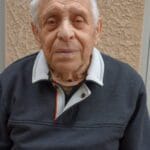
Mikhail Rabinovich, z"l (Ukraine)
I was born in 1930 in Chernigov, Ukraine, into the family of a laborer. My mother was a housewife, so it fell on her to take care of the family and her sick mother, who could hardly get around. There were three boys in the family: I was the youngest; the oldest was ten years older than me; and our middle brother died in an absurd way in 1934, when the doctor wasn’t attentive enough after my brother stepped on something. He died of blood poisoning two days later. Right up to the war my parents had still not gotten over the terrible shock.
I was eleven years old in 1941, and in the third grade. On June 22, 1941, our class was on a field trip to see a movie, and while we were watching it we heard that the war had started. No one thought or knew what might happen next. Our relatives came to our home, and our friends were discussing what to do, where to go and where to stay, and what would happen to our sick grandmother. My father remembered that during the First World War the Germans didn’t bother the Jews. But after a few weeks, refugees began arriving from other areas, and among them were many orthodox Jews telling us how the Germans were persecuting the Jews. We decided to leave.
Organizations and factories were leaving. My father worked at an Artel, where there were stables with horses and carts. We had our own horse and wagon, and the Soviets had created an Artel where Jews stabled their horses. My father went to work and came home with the horse and wagon, telling us that the authorities had all fled and people had taken the horses. We loaded some of our belongings and put our grandmother on the wagon, and in the course of three weeks reached Voronezh. That was August 1941. As we left, we could see that Chernigov was on fire.
We went to Otrozhka station near Voronezh, where they’d formed trains for evacuating refugees. The trains had boxcars used to transport cattle but had been converted to carry people. We loaded up, and after a month and a half were at the edge of Southern Kazakhstan. Our train was coupled and uncoupled repeatedly, maneuvering in order to avoid being bombed.
We arrived at Mirka station, 200 kilometers from Dzhambul. The village there, Kuzminki, was a post-revolutionary settlement of former-Russian and Ukrainian Kulaks. We were put in a small “saman,” a duplex-type cottage. What is a “saman”? It’s a home made from bricks that are created by mixing straw with clay solution, both roof and floor covered with the clay. The floor had to be redone each week, so we prepared the clay solution ourselves and smeared it on.
The climate was hot: the summer heat was somewhere around 40 degrees Celsius (104 Fahrenheit), and the winter was cool but without snow. We had to survive somehow, so my father worked as a cattleman on a ranch that belonged to a sugar factory. They fattened the cattle as a supply for canned meats sent to the front. We kept warm with straw, and deadwood known as “Kurai” (connected with bundles of straw and other deadwood).
I would go to school and after lunch help my parents. Shortly after we arrived my grandmother died, and my mother suffered from heart failure, so our needs fell to my father and me. My older brother was drafted into the army in 1940 and served in the Far East, but was transferred to the front at Stalingrad. He was seriously wounded in 1942, but recovered. In 1944 he transferred to the reserves, found out where we were through the Red Cross, and traveled there.
We were given land and grew corn, which we were allowed to water only at night. We gathered and shucked it, then ground the corn into flour with two stones. We also received bread with our food ration cards.
By the end of 1944 we felt the war was coming to a close and decided to return to Chernigov, where we had a home, and applied for permission to return. When we returned, at the end of 1945, we found that our house had been completely plundered. We were told that Germans had been billeted there. I went to work as an apprentice plumber in a factory and studied at night school up to the ninth grade. I took my tenth grade examinations without attending school.
Shortly after the war we buried my mother. She’d had two strokes. My father was alone. My brother married and went to America with his wife and their two daughters. I attended the Romny Military Automobile School to become an engineer-mechanic, graduating with honors. I got married before I graduated.
Based on my choice, I was based in Kiev and all across Ukraine. I also worked on the Kamchatka peninsula and Sakhalin Island. On Kamchatka (13 kilometers from the city center of Petropavlovsk-Kamchatsky), I was chief engineer of an automotive repair battalion, and was then transferred to Sakhalin Island, where I received the rank of major. I served six years there, then transferred again to Kamchatka. Our son Aleksander completed the tenth grade there.
I finished my service at the rank of major, and received a three-room apartment in Kiev. I worked as a civilian in a factory supply department, where I managed the component supply and spare parts after the design department made their requests. I supervised a group dealing with supply requests related to quotas.
It was at this time that my family considered the issue of leaving Ukraine. In 1989, our son Pavel, who was a computer programmer, received his immigration approval from Israel. They waited in Italy for approval to go to America, then went to New York once that came in. He then invited us to join his family. We knew we were going to Tucson while we were still in Ukraine. Pavel would visit us in Tucson until he moved here himself. Of course, it was difficult to register the customs documents, but we got through it and found our new homeland in 1991.
We were well met in America. Separate apartments at “La Mirada” were prepared for my wife and me and for our son Aleksander’s family. We soon went to work selling flowers and bought a car. Eventually we opened an automotive business and opened a store, “European Market.” I worked at the store for a while, though now our son Aleksander and his wife manage the store.
Here’s another thing I want to say: thank you America, for providing for us in our old age.