
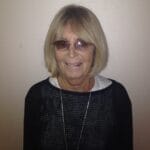
Mirjam Wheeler, z"l (Czechoslovakia)
I was born in August of either 1936 or 1937, in a very small village in Czechoslovakia called Kurima. I don’t know the exact year, or even date in August I was born, but it was either August 18 or 23. Our village was primitive, without plumbing or electricity, but it was nice. My father and his brother married two cousins, and we all lived together with my grandparents there. I think my father’s name was Ernst Stern, but I’m not sure. I think my mother’s name was Elenor. I had an older sister, but she died before the Holocaust. My sister Judith survived the Holocaust too, but my brother was found hiding in the woods and was killed. He was eight or nine years old at the time.
I think I was five years old when our parents sent us to Hungary to live with my aunt. They divided us children up to make sure that if anyone was captured it wouldn’t be all of us. My cousins and me were caught crossing into Hungary, and I remember being in prison. We had to go to a horrible orphanage for about a year instead of staying with my aunt, but we could at least visit her. My sister made it, but when the Germans entered Hungary we were smuggled back to Czechoslovakia. This was the last time I saw my parents. According to my sister, who wrote a book about the Holocaust, we were only home for about two hours. My father arranged for us to be hidden in different places.
My sister and I stayed with a Catholic couple, in their back room. We couldn’t have the lights on, and we couldn’t go outside. But one of the neighbors betrayed us and called the Gestapo. In the middle of the night, three trucks of German soldiers with guns and dogs came just to capture my thirteen-year-old sister and me. I was six at the time. I think they did these kinds of things just to scare people.
I was put in a Gestapo prison, an old castle on a hill. I don’t know how long I was there, but they kept asking me where my parents were and where other Jews were. My parents had been very smart and had never believed what Hitler said. They also hadn’t told us anything, because they knew it would be dangerous. We really didn’t know anything. The Germans would try to bribe me with chocolate to tell them.
One night a Czechoslovakian guard came and told us to follow him. He led us out of the prison, which was a real miracle because people didn’t generally get out of Gestapo prisons. My sister went into the forest with a group of people and I went into hiding with another family. They eventually caught my sister; she ended up in Ravensbrück. The husband in the family that hid me was anti-Nazi, so he was in hiding too. They didn’t realize what was involved in hiding me, and that they could have all been shot. They had four children.
Eventually, the family also had German soldiers living downstairs, even while I was hiding upstairs. The Germans were always looking for the father, meaning they could find me as they searched. The woman got very scared about this. All this caused fights between the couple, because the woman wanted to give me up. But he wouldn’t let her. She didn’t do it, but she’d always tell me horror stories about what the Germans would do so I’d stay quiet. It was very scary thinking that they could find me.
While I was there I got very sick and the couple didn’t know what to do. There was a Jewish doctor in hiding in the area, but they couldn’t get him, so another doctor came – I think a German doctor – who gave me medication. I recovered eventually, but the woman was always so worried. She didn’t know what to do. I’d call for water but she couldn’t think to even take care of me. All I knew was that if I didn’t call for water I’d disappear. I’d hear her talking to her daughters, saying things like, “How are we going to bury her? She’s not supposed to be here!” But here I am.
My parents must have told everyone where we were hiding, because when the war ended my cousins came for me. We all went back to my house in the village to wait for whoever else might come home. Our parents didn’t. My brother and grandparents didn’t. But my two cousins and my sister and I did come back. As it turned out, my father and his brother were sent to Sachsenhausen concentration camp, where his brother died just before the war ended. My father died there the week after the war ended. My mother was supposed to be sent to a concentration camp, but she became ill. My sister and aunt went to see her, without papers, and a woman on the train gave my sister fruit and bread. My sister didn’t know the blessing, so she told the woman she’d wait until my aunt woke up. It was a miracle that there were no soldiers onboard. My sister got to see my mother one last time before she passed away.
We lived with my aunt for a year, and we just barely got out of Czechoslovakia before the Russians closed all the borders. After that you couldn’t get out until 1958 or so. We went to England, because the English were willing to take 1,500 children. However, they could only find around 700, because small children had been put to death right away. The place in England where we lived was wonderful.
I was in England for 14 years or so, and my sister and cousin had gone to America after they got married. I joined them later, but even though we were British citizens at that point, I had to go to America as part of the quota of Czechoslovakians visas. So I had to wait four years. I arrived in America in the late 1950s and lived with my family in New Jersey for a year, then moved to Manhattan until I moved to California. I moved to Sierra Vista, Arizona, 10 years ago.
Some things about the war are vague to me, because I was pretty young. But it was very hard to be all by myself back then, and the houses had to stay dark all the time when the people hiding me left. The Gestapo usually came at night, and one time the woman I was staying with pushed me under her bed. No one was sure if they’d find me.
There was something really good that happened from all of this: when I lived in New York I would write to the family that hid me. They told me the father was very ill and that they couldn’t get medication for him, so we were able to get the medication through the Red Cross in Holland. He lived another three years after that. I didn’t keep too much contact with them after that, because I don’t know Czechoslovakian anymore. Still, that made me feel good.