
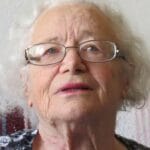
Rakhil Yakover, z"l (Ukraine)
I was born in Odessa, Ukraine, located on the shores of the wonderful Black Sea. I was the youngest of three daughters. The oldest was Esfir, and the middle daughter was Liza.
Our father, Sanya Abramovich Yakover, worked in an office and our mother, Dora Moiseyevna Yakover, was a housewife. She took care of the family, sewed for us girls, prepared meals, cleaned and did the laundry all by herself, right down to gluing together the broken over-boots that we wore over our shoes. Her life was not easy.
My father began working as a salesman in a children’s clothing store in 1934. He was quite intelligent and clever, but he made many mistakes. Prior the revolution he was a salesman for a textiles store. After the revolution, when the NEP came into being, he and a friend built a sign that read “Yakover and K,” thinking they’d start a business. After NEP was abolished we were thrown out of our apartment. This was the winter of 1929, when I was a baby. My father was not allowed to live or work in the city, but only in the region, and my oldest sister was forced out of the Komsomol, expelled from school, and sent to a shoe factory to cut leather. She was just fourteen years old at the time; Liza was six. Our parents found a place in Chubayevka, where my father worked at Razdelnaya transfer station, two-to-three hours from Odessa on the train.
There were several years of famine in Ukraine. I remember my mother saying, “eat a big slice of radish and a small piece of bread,” and though we didn’t like it we had to survive. This was in 1933.
Liza rode a tram to a school that was quite far away. When I was four years old I’d ask Liza to give me homework, and she would tell me the assignments. I would do them before she returned from school and she would check my work. By the time I was five I was reading, counting, and writing. Liza had learned many Russian and Ukrainian poems, which she practiced out loud, and I repeated what she said like a parrot until I’d memorized everything. I knew many poems on the school’s syllabus.
We moved to Odessa after some time passed, and lived in a house not far from the city center, until the war began.
My mother had two sisters and two brothers, but by the time I was born one uncle was living in Palestine and another had died in Belgium. I don’t know how he died. I know that he was sympathetic to the communists. My mother’s oldest sister had five children and was busy with a family. By the war, the children were already adults. My mother’s younger sister was a doctor. She was immediately drafted when the war began, and on June 23, 1941, she was transferred to the Belorussian front. The only letter we got from her came from the city of Borisov. The Germans occupied Odessa by October, and communication with Borisov was lost. My sister tried to find my mother’s little sister during the war and after, even in the Boguruslan archives. The answer was always the same: “she’s not listed among the living or the dead.”
My father had three brothers. The youngest was killed by bandits during the civil war, and the middle brother, just married, went to Palestine and lived in Haifa. My father was the oldest of the boys, while another of his brothers lived and worked in Odessa and had two daughters. This uncle died at the front while my aunt and their daughters were evacuated to Azerbaijan. They returned to Odessa after the war.
My oldest sister got married before the war. Her husband served in the military in Moldova, on the border with Romania, and was immediately sent to the front. When they broadcast Molotov’s announcement that the war had begun on June 22, 1941, my sister said she would go to the Voenkomat to be sent to the area where her husband was. She became eligible for the draft, but when all of the chemists in the city were mobilized and sent to the Bacteriological Institute in Odessa, she went as well. They filled bottles with fuel (Molotov cocktails) to help at the front, which was approaching Odessa.
Her hands were burned in an accident there, and because of this they evacuated her out of Odessa. Luckily a kind-hearted classmate from her post-graduate school helped her when they left. She could not, in fact, use her hands. They evacuated on foot with the Pharmaceutical Institute, where she had graduated in 1938 and was then teaching. They departed for Nikolaev on June 30, 1941, walking because Odessa was cut off. People tried to get to ships and were attacking each other, but the ships would sail and the fascists would sink them. My sister made it to Uzbekistan. The last message we received from her came from Mariupol, on Crimea, but after that all communication with her ended. Her husband was in a hospital in Rostov-on-Don, though later she received notice that he’d been killed there. We still don’t know what actually happened to him.
Liza and I went to different schools; hers was Ukrainian and mine was Russian. At the beginning of the war I had finished the fourth grade and Liza the tenth. Her graduation night was three days before the war began. Since she got excellent grades, she had just been accepted to attend the Industrial Institute. But the war changed that. And so began a different life.
On the evening of June 23, 1941, German airplanes bombed Odessa, but didn’t return for a month. The bombing began around July 22. They’d often announce air raid warnings on the radio, and the sirens would blow. At first, people ran from their apartments to bomb shelters. Once everyone got used to it, they didn’t pay as much attention. The children would gather shell fragments, rejoicing and comparing whose pieces were larger and hotter. There was an anti-aircraft gun on our neighbor’s roof that deposited gun shells as well. There were two entrances to a basement where we stored various items and fuel near our building. When the steady bombardment began, people started going deeper into the basements. They’d found that the corridors were connected to catacombs on which Odessa stands.
At the end of July the fascist forces were closely approaching Odessa. They were stopped 20 kilometers away in Dalnik, where Odessan men mobilized and young untrained boys were dispatched. The boys from our neighborhood went there. None of them survived. I remember the bombardment began with artillery barrages, long-range shells that fell all over the city. At night we were afraid to sleep at home and gathered in the yard to watch for the enemy aircraft that rained down bombs. And so many incendiary bombs! Each neighborhood put together a schedule where people would go on the roofs to watch for incendiary bombs. And we watched for spies. This continued for 75 days, to mid-October. We still had to live, eat and sleep, and to wash our clothes as usual. My father continued working, and my mother would walk to the market. She had to cook our food. When anyone left the house the others waited tensely for their return. Very many people died in the bombings.
There was a garrison bath not far from our house where the soldiers washed up, including those from the front. The Germans tried to destroy the bath, but they destroyed all the buildings around it instead. Next to the bath stood a four-story house which was destroyed by one bomb. I remember that in the morning my father and I walked past that house, and from under the rubble we could hear a voice begging for help. What could we do? This was a terrible way for a twelve-year old to survive. It torments my conscience.
It continued this way up until the fascists began to break into the Crimea. Odessa was a major strategic point, a major sea port, so they needed to defend it with all available forces. It was the gateway to the Crimea. Fascist forces outflanked Odessa and made for the Crimea, while the Red Army retreated.
During the night on October 15, 1941, our airplanes dropped leaflets, which I will remember for the rest of my life: “Respected residents of Odessa. In view of the fact that enemy forces have surrounded the city and are making for the Crimea, and our food base has been taken, our forces must retreat temporarily from the city.” They urged us to fight the enemy, to create partisan units, and to use the city’s catacombs to make it easier. At the end was this postscript: “Odessa was and will be Soviet.” It was one of the heaviest moments of my life. Several years later, in 1959, I was in the Soviet Army Museum where, in one of the halls dedicated for the defense and liberation of city-heroes, I found that leaflet. After 18 years, I stood and read it, crying.
I began a new life on October 16, 1941: a life of occupation, a life under oppression. There was anarchy in the city until 4 o’clock that day. Soviet forces were retreating, though the Germans had not yet entered. People plundered stores, taking sacks of food; horses ran through the city. The water was cut off. People searched for deserted wells or got into long lines for water. The first German units entered Odessa that evening.
To celebrate seizing the city, the German command held a banquet at the Soviet NKVD building. During the festivities the building was blown up, apparently by partisans. In answer, the German command instituted true terror. Soldiers burst into apartments and seized everyone they could get their hands on, dragged them into the streets and hung them from trees. In Odessa there’s a street called “Lieutenant Schmidt Street,” which was once Aleksandrovskaya Street. This street runs through the city center from the train station to the sea at Peresip (an area of Odessa), where trees line the streets. People were hanging in every tree there. They hung 200 people for every dead officer, and 100 for every dead soldier. Near the cemetery, they built stanchions to hang people from.
The next day, orders were posted stating that all communists and Jews with families were to appear for registration and to bring basic necessities. On that day, people trudged in columns not knowing where they were being taken. There was a lot of down feathers from pillows in the city because the Germans thought nothing of ripping everything up.
Those who wound up in the first groups went absolutely straight into hell: to the village of Bogdanovka, where the men were ordered to dig ditches and to bury their wives and children alive, then were executed by firing squad. A man in our group had managed to get away from Bogdanovka. He told us what happened there and was blinded by tears from the horror he had gone through.
Our group ended up being taken to an Odessa prison. We saw the gallows on the way there. Closer to the prison, not far from the back entrance, we came upon a mound of dead bodies. Dogs were running around and on the mound. We were kept in the prison until November 6, 1941. The whole time we heard screams and shots fired, and in the evenings soldiers would seek out young women. We would sit on the beds hiding my sister under the covers until everything subsided.
Of course, we had little to eat. We ate what we brought with us from home. When there was finally nothing left, my father talked to a guard (to whom he had given silver spoons as a bribe) and they let him go out the rear door. My father reached our home and took food, but our housing caretaker had brought in a Romanian soldier who threatened my father. My father told him: “Shoot me. I have two daughters and a wife in prison starving to death.” Even the Romanian pitied my father and let him go.
We were released on November 6 (they claimed the Germans had taken Moscow and therefore we were freed). We made our way home but weren’t allowed in our apartment, so we lived with two other families until January 1942, when all the Jews were rounded up in the area of Slobodka (an area of Odessa), where a ghetto was established. People lived where they could there: some in schools and dormitories, some in apartments with various other people. After some time they began to organize roundups to herd people together and take them by wagon to a train station. At the station they stuffed them into boxcars so full that people couldn’t breathe, and took them 90 kilometers away to Berezovka station. From there, the trains went another 50 – 60 kilometers to the village of Domanevka.
The winter of 1941–1942 was very snowy and cold. During the day it would melt a little and would be wet underfoot, but by night everything froze. And still we were pushed further and further. All along the way we heard shots fired: they were shooting the elderly. Some dared to joke that there’d be a machine gun at the next turn to execute everyone.
We finally reached the cursed village of Domanevka. There were people who’d been forced to go there earlier living in rooms without windows or doors in a former school. Hunger, cold, dirt; Domanevka persecuted us constantly. But the most terrible thing was coming – a typhus epidemic. One after another, people died. As soon as a person died he was taken to what was called “the hill.” There truly was such a “hill” farther from where we lived, where people died and were thrown into graves. My mother died from typhus, and my sister and I became sick with it.
After some time passed, when it became warmer, we were transferred to a different camp in the village of Akhmechetka. Conditions there were even worse: we lived in barracks on a former pig farm. The camp was enclosed by ditches and barbed wire. The camp was guarded by locals. There was no water nearby, so we would leave the camp in groups of 10, one of which oversaw the group. If someone tried to run away, or did run, they would shoot that person put in charge. For food they gave us one cup of corn kernels, or a cup of flour.
The Germans used the collective farms but needed workers, so they sent people from the farms to select people to work. Women were not allowed to bring their children with them, so at the beginning only single people were selected. Once the single people were all taken to work at the farms, they began using people with children. Young mothers hoped to return and take their children back with them. This didn’t happen often, because the hungry children, with extended bellies and thin legs, didn’t survive after their mothers left. The grown and the aged died as well. People worked from sunrise to sunset, all day in the sun, barefoot. Their main job was to weed the fields and gather ears of corn off the stalks. The workers were always overseen by local policemen.
I was around thirteen years old, and young people weren’t sent into the fields. The teenagers worked in the huge garden at the collective farm, also from sunrise to sunset. We weeded the beds there, and when the cabbage ripened and turned we cleaned caterpillars from them. We were bent over all day, every day. It’s true that we sometimes were able to get carrots, radishes, cucumbers, et cetera. I didn’t eat cabbage for about ten years after that. An old man was in charge of the garden who treated us well. He would offer us watermelon when it was ripe, though we weren’t allowed to take any home with us. We lived in a hut at the edge of a village and slept on beds of reeds. At night the mice ran around the hut, but it was better than the camp at Akhmechetka. We worked on the farm until late fall, and when the season was over we were sent back to the camp at Akhmechetka.
I don’t remember how, but my sister and I managed to escape to the village of Koshtov, and persuaded local authorities to let us stay through the winter. We were prepared to take on any work, and to our surprise they let us stay. We did all sorts of work inside the barns and shucked corn. They planted hemp in the village, which we learned how to cut and soak in the river. When it was completely sun-dried, with the aid of a very simple tool we pushed out the center of the plant. We learned how to use a spindle. With the yarn we spun we made absolutely everything: shorts, shirts, bandanas, socks, slippers and other things we used in our home.
We were taken back to Akhmechetka in September 1943, and survived a fire there. It happened in the middle of winter, at night. We ran from the house, barefoot and naked on the ice. My sister wound up with huge, deep abscesses, and I had a festering boil on my neck. But we gradually felt that the situation was changing.
We weren’t sure where the Red Army was until we saw troops moving, and by March we felt no one was interested in us anymore, and we slowly started heading toward Domanevka. Along the way, we passed Koshtov farm, where we had worked. We were tired and stopped there. At one end of the farm there was an elongated room dug into the ground where they’d once kept chickens. At night we heard cannon fire, and in the morning we spotted soldiers speaking Russian. We were surprised and scared. It all became clear when we left our cellar and realized they were Red Army soldiers. The Army was moving forward, pushing out the enemy, and we followed them. Odessa was liberated on April 10, 1944, and we returned to our home city on April 16, tired and hungry.
We went to our old building, where a very decent Russian woman took care of us. We called her Aunt Manya, and we were very grateful to her, not just for ourselves. When the Germans came to chase out the Jews, Aunt Manya wanted to save one little Jewish girl, Klara, who she loved very much. In turn, Klara also loved Aunt Manya. One day one of the neighbors said to Aunt Manya that if she kept the girl they’d tell on her, and the Germans would take both the girl and Aunt Manya. Klara and her entire family perished.
Our apartment was occupied by now, though we didn’t think to try to claim it. We were told there was nothing left of our parents’ furniture. When we were close to Odessa, six days before the city was liberated, we saw smoke and could smell something burning. It was a grain elevator. The Germans had dumped its contents into a huge mound, and mixed it with tobacco. They then doused it with gasoline and lit it on fire. But the locals shoveled up the steaming pile and mixed more grain into it, then baked bread with the grain. It was the first time we had eaten this sort of bread.
A woman who lived in our building was an orphanage director. She asked us to visit her, and offered me to go to live in the orphanage. I asked for my sister Liza’s consent. I agreed because I knew that I would be well fed, clothed, and knew where I would sleep. I could go to school there. Liza agreed. We filled out the documents right there, and I left to live in the orphanage. My sister Liza found a job as a librarian at a naval school. After a little time passed, Liza was offered a one-bedroom apartment.