
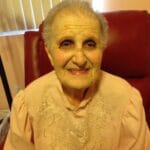
Sara Rozenfeld, z"l (Ukraine)
I am Sara Rozenfeld, born in 1923 in the city of Pervomaysk, Ukraine, Odessa region (now Nikolaevsk region). Our family was small: my father, mother, and me. My father was a bookkeeper and my mother was a housewife. I graduated from the tenth grade in 1941 and was ready to enter a medical institute. That was on June 19, 1941. The morning after our graduation party, we heard the news of Germany’s sudden attack on the Soviet Union. The war began on June 22, 1941.
This caused fear, anxiety, and feelings of helplessness. German aircraft were soon bombing the city, and German artillery began firing on us. Their goal was to destroy the bridge over the Bug River, and because we lived in that area we were subjected to constant danger. One of the first bombs fell in our courtyard. The building shook, and there was a huge crater, but our home was still standing and so were we. G-d himself had obviously saved us.
There was a panic in the city. German propaganda played on personal radios, appealing to the Ukrainian locals not to leave their homes because Hitler was only after the Jews and communists. It became dreadful to stay at home, and we realized that we had to leave Ukraine.
Because of his age, my father didn’t work and wasn’t called up to the Army. He went to the train station and found out that the last trains were leaving, that after that all train movement would stop. We prepared quickly, using old clothes to make bags and throwing warm clothes into them. We added rope to carry the bags on our backs. It constantly rained that summer of 1941, it was cold and wet. We took the vinyl tablecloth from the kitchen, but left everything else at home when we went to the train station.
Prior to leaving, my mother baked lepyoshkas out of the flour and water we had left. There was a train at the station with four open-air cars and three iron cars for hauling coal and other loose loads, which were also open-air. Our aunt’s family of three joined us. To our good fortune, our boxcar was connected to a train headed east, to a Machine Building Plant in Orenburg. The trip was very difficult, and we were bombed several times along the way. The train would stop and they’d turn out all the lights and the train’s furnace. They’d order us off the train to run into a field, where we’d lie on the ground until the raid was over. It took us two weeks to get to Orenburg.
We were sent from Orenburg to Kubandyk, on the Sakmara River, where there was a logging village. A year later the Kiev Mechanical Factory transferred there. It had been converted to a military factory that made antitank grenades and hand grenades for the front. I soon started working there, first as a laborer and then as a drafting technician. The work was not easy. We worked three shifts in difficult conditions without counting our hours, until we used up all the available materials. Most of us were young.
After the war ended in 1945, I went to study at the Orenburg Medical Institute. After three years there, I transferred to Odessa Medical Institute, and our family returned to Pervomaysk. I graduated in 1950 and married Abram Wiseman, who graduated from Odessa Pedagogical Institute. We were sent to work in a village located in the Izmailsky region, where we stayed for eight years.
The creation of the state of Israel gave us great joy and pride, and we decided to go there once the chance arose. In 1998 we departed for Israel. Our daughter and her family left for America at that time, and in 2010 our family finally reunited in Tucson, Arizona.