
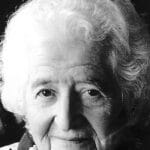
Sara Turkin, z"l (Poland)
My name is Sara Turkin, born with the last name Appleman on December 15, 1919, in Janow, Poland.[1] Janow was close to Pinsk (now Belarus), and was a little town with a mixture of Jews and non-Jews.
My father was Moshe Mendel, and he owned a small grocery and goods store. He was a hardworking man. My mother’s name was Feigel Levine. She was a housewife who raised the children. I had four brothers: Yisrael Hersh (Israel), Aaron Dovid (David), Shmuel (Samuel), and Leibel (Louis). I was the only girl and the oldest.
We spoke Yiddish in the house and celebrated all the Jewish holidays. I didn’t see any anti-Semitism there before the war. Jews and non-Jews got along, but it all depended. They would say, “This Jew’s a good one and this one isn’t,” so it depended. If you had good non-Jewish friends it was because you were a good Jew. That was life: we didn’t know any other way.
We were aware that Hitler was in control in Germany, because at night groups who agreed with the Germans would go around and break windows. The Christians knew about them. Even in the daytime, the non-Jews would give you a push: before that there had been nothing. We knew not to walk on the sidewalk when we saw Hitler supporters coming. We began to feel the changes about two years before the war, in about 1937. We felt uncomfortable.
In 1939, when the Russians first arrived, things were fine.[2] It wasn’t the same as living with the Poles, but it was okay. When the Russians came in it was actually like freedom, because they wouldn’t let people say “I’m a Jew,” or “You’re a Jew.” They would say, “You are Hebrew,” which was more friendly. With the Russians, life continued as usual. They were there for a while, and then the Germans came in 1941. They started by bombing us, and then they occupied Janow.
We started hiding when the Germans came. I remember that we had to hide in cellars during the day with other families, and we would only come out at night. We did this for a few months, and then the Germans got us when we went back to our house.
I remember that it was morning and still dark. They took us in wagons to Pinsk, where they had created a ghetto. The ghetto was in a large section of the city with barbed wire all around it, and many families lived in each house. Jews from all over that area went into the Pinsk Ghetto. We didn’t have a steady place to stay until we went into the ghetto. We knew that the Germans were killing Jews.
Our house in the ghetto had three or four families in two or three rooms. We slept on the floor. We ate whatever we could get and that’s how my oldest brother Yisrael got killed: he left the ghetto to get food.
The Germans stayed outside the ghetto but gave the responsibility for the ghetto to the Jewish people. There were also Jewish police there. We ate potatoes and bread and could cook. We were lucky because my younger brother was sent to the Germans to work in their kitchen. He would bring potato peels and old bread home with him. I was assigned to work outside the ghetto as a servant for a Christian family. After work I would return to the ghetto.
There were no schools or hospitals in the ghetto. When they shot my brother they had to put him in a house. Children were all skin and bones, laid out on the sidewalks and in the streets, their bellies large from hunger. I was lucky because I could eat where I worked and sometimes they’d give me something to bring to my family. There wasn’t time for friends in the ghetto; by evening, everyone was tired and hungry. We were squeezed in with all sorts of people.
We were just waiting for the day they would kill us. There were days when the Germans would walk around and take people out of the ghetto for health reasons. I remember one night someone came around and said the Germans were coming, so I hid my mother because she had a problem with one arm. The Germans would come in and remove the old or the sick, and little by little everyone was leaving. We knew they were taking them out of the ghetto to kill them. The Jews would have to dig holes and big ditches, and the Germans would kill them there. It wasn’t every day, but maybe once a week or every two weeks.
In May 1941, when they decided to liquidate the ghetto, my brother Aaron Dovid and I decided to run away. By 1940, my father and one brother had already died from either a stroke or heart attack. One morning we somehow snuck our mother and little brother out of the gate with us. We went with those who were assigned to dig potatoes. We stayed all day, and when they began to return to the ghetto we went further into the field and covered each other with branches from the potatoes.
After dark, we decided to try to get to the forest. Behind us, we could hear big trucks taking everyone from the ghetto to the place where they had dug the holes. We could hear the gunshots. There was a Christian Russian at the river and I told him in Russian where we were going. I asked if he could get us across the river, which he did.
It took us more than a week to walk to the forest. We ate carrots we found, or stole food from gardens as we walked at night. We hid and kept still during the day.
We knew a few people in Potapovichi, Poland, a small village in the forest. The forest was called Zavishche Vald. We knew of a man who lived there and had a large farm. He used to come to our city to trade with us. He was not Jewish. We finally found someone we knew and waited for night to knock at the door. When the woman saw us, she almost fainted because if non-Jews hid Jews, even in such a small town, their homes would be burned down. Nevertheless, they hid us in their barn and brought us food.
In the meantime, two Jewish boys from Janow had been caught and tortured in a school. They knew there were other Jews around, since the boys had left the forest to find food. The boys were tortured to the point where they were killed, but they never said a thing about other Jews hiding in the forest.
One night, while I searched for food, I heard the noise a soldier’s coat makes, so I hid behind a gate as a German soldier passed. I was almost captured so many times. The woman hiding us wanted to keep doing so but told us she was afraid. She gave us food and clothes and asked us to return to the forest, which we did.
At night we stole potatoes and such from gardens, and sometimes we stole chickens as they slept under the trees. It wasn’t kosher, but we didn’t have enough food. We managed. We dug holes in the forest, covered them with branches, and sat in the holes during the day. We didn’t want the airplanes flying overhead to see us.
One night, as we were going to a town, we met a partisan and asked him to take us to his group. The partisans were Russian soldiers that had been dropped behind enemy lines to organize resistance groups. Later, Jewish partisan groups rose up as well, but at first it was just Russians. The group was in a forest about 40 kilometers from Pinsk, and there were maybe a few hundred men and women but not many children.
The partisan group worked at night, sabotaging trains with homemade bombs and ambushing German soldiers. They had contacts of some sort, because they knew every step the Germans took. The women stayed behind, but were given rifles to shoot anyone who came after us. Those rifles were dropped behind enemy lines for the partisans. My brother and I both had rifles that the partisans taught us to use, though I never had to do that.
More Jews began to join the partisans from towns all over the area. Many Jews came from Janow, but there were some that had run away from other areas in Poland. Others came from far away. The group got bigger, but that also brought on typhus and other sicknesses. Many people died.
The partisan group was together for about three years. In the winter, we begged for potatoes and bread. We knew which people would give and which to avoid. Those we avoided were afraid the Germans would go after them if they knew they had given food to Jews. We moved all over the forest, but we only stayed in one place for a few months. When someone found out where we were, we moved.
Most people who got sick simply died, though I was lucky: I became sick just when we heard that the Russians were advancing on the Germans. When we got to Ravalovski, the Russians helped me take care of my mother who was sick with typhoid. We all eventually became sick with typhoid, but the Russian doctors helped us.
The older of my brothers, David, left to fight with the Russians while the rest of us were sick. When I recovered, I was only skin and bones. I had an ear infection that got so bad that a Jewish pharmacist in the area brought a Russian doctor to see me. He applied hot compresses over my ear and said that a proper cure would be hard to manage until the war was over. That doctor’s compresses healed me. I remember that he was so happy that he had cured me.
That was the end of our partisan days. The sick wound up in a Russian Army hospital, and all the young men left with the Russians to fight the Germans. This was either 1943 or 1944.
We finally started to return to Pinsk, though I don’t remember how long it took us. All the houses there were bombed out. Hardly anything in the city remained. We found a house with no windows or doors, and we closed up the holes with boards we found. A man we had known before the war moved in with us. We had a tiny kitchen with a broken oven, but we started to make a house out of it. This was in 1945, just after the war ended.
We decided not to return to our home in Janow, since we knew there would be nothing there. Somehow the Haganah started coming in, looking for Jewish people to go to Palestine.[3] They made passports for us and put us on a train from Pinsk to Chelm, Poland. From there we went to Lublin, and then to Czechoslovakia. We had to do it illegally at night, traveling with Greek passports and with different names. Somehow it worked out, and we went from there to Austria in trains. Then we walked through the mountains to Hungary. We were happy to be going to Palestine.
We were caught once as we crossed a river in Belgrade, but again they let us go. From Yugoslavia we made it to Italy, but we missed the ship and had to wait for the next one. We were told that our original ship had been caught by the English, who weren’t letting anyone enter Palestine. While we waited in Italy, we began to get to know the American soldiers. We had relatives in the United States, and gave the Americans their names and where they lived. That is how we got in touch with my mother’s sister in California.
[1] This story comes from an interview by the University of Southern California’s Shoah Foundation.
[2] The Soviets signed a non-aggression pact with the Nazis in 1939. Part of the pact was an agreement involved splitting Poland between the two countries.
[3] Haganah was a Jewish paramilitary organization in Palestine which became the core of the Israel Defense Forces (IDF).