
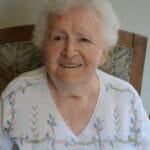
Tayba Steklova, z"l (Poland)
My parents lived in Kovel, in the Volynskiy region, in Poland. I was born there on December 30, 1928. We lived in our own house with a big orchard. My father worked at the Magistrate (City Hall), and my mother was a housewife. In 1939, the Soviets came to power in Poland, but my father remained in his position, though the name was changed to Gorispolcom (The City Executive Committee).
The war started on June 22, 1941, and three days later we were evacuated. Because my father worked for the government, he stayed and didn’t go with us. Four of us were traveling: my mother, my brother, my sister and me. We traveled through Kiev and Kirovograd, stopping numerous times along the way. At one station we stopped for a long time and were able to eat only once in three days.
At the beginning of July the train began to move again. The Germans were bombing Kremenchug very hard when we got there, and had blown up a railway bridge. We all jumped off the train and ran in different directions, and because I’d fallen behind the train later left without me.
It’s difficult to describe what I went through and how much I suffered. As a child, I got grey hair in two days. I was not the only one who couldn’t make it back to the train. We got help to catch up to the train and I met my family again in Kharkov. After Kharkov, we hid in the woods during the day and during the night we traveled by foot or sometimes we were able to catch another train. We were hungry, exhausted, and had sores on our feet.
Near the end of July we made it to the Penza Evacuation Center. There we stayed for two weeks. We had lice, so we were all completely shaved (I am so embarrassed to write about this), but we got treated.
By the middle of August we were transferred to the Penza region where we were put in local people’s homes. We had no belongings – just the clothes we were wearing. Everything we’d brought with us was lost as we traveled. It’s very difficult to recall these times. I remember how I ate the grass called goosefoot. We all worked in communes, and for our work there we got grains and we were also allowed to pick up small potatoes. It was a very hard time.
When the Germans entered Kovel, the local government evacuated to Samarkand. My father was among them. He found us through the Buguruslan Center and joined us in the beginning of September, 1941.[1] He started working at the finance office, and in 1945 he was transferred to the regional financial office in Penza. We moved with him and lived there until we moved to the United States. I worked in Penza at the Radio Center as a clerk and also attended evening school. Later, I started working as an administrator at the hotel and worked there for twenty eight years. At night school I met my future husband, Solomon. We got married in 1954 and have two children: a daughter Zhanna and a son Boris. Zhanna lives in Tucson and our son lives in Israel.
All of our relatives, including my grandmother, her children and grandchildren who stayed in Kovel, died during the war. The town was completely destroyed and a brand new city was built there.
Together with my daughter’s family, we moved to Tucson in September 2000.
[1] During World War II the Soviets established the Central Information Office in Buguruslan as a means of tracking evacuees during the war.