
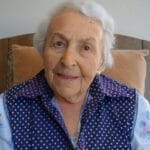
Tsiliya Lipkina, z"l (Belarus)
I was born in Gomel, Belarus, on August 18, 1923. My mother was a housewife and semi-literate. My father said he finished the fourth grade. He was a bookkeeper for the railroad. I remember that he was very well-read and had beautiful handwriting. When I was studying later at the institute in Minsk, and would write letters home, he would find my mistakes, underline them, and return the letters to me. I had a brother two years older than me and a sister three years younger. My sister lives in New York with her family; she is the person who invited us to come to America. My brother was in the war as a tank crewman, was wounded, survived, returned home, and finished law school through correspondence. He died in 1995. My mother’s parents died before I was born. My father’s father died when I was little, but I remember his body lying on a bed of straw on the floor. Babushka, my father’s mother, lived with us; she died when I was in the seventh grade.
Four families lived in our communal house on Proletarskaya Street, though the entranceways were separate. I still remember it was a beautiful street near a river with many trees – a full orchard of chestnut trees. When they bloomed they were beautiful, like white candles. Old Believers lived there, and they built a church on the riverbank that has since been restored. As children we would climb across a fence and pick their apples, or run to a small river and swim all day.
In 1930, by order of Stalin, all the churches in Gomel were destroyed. On our street the church was very beautiful; its high cupola gleamed like gold. We all watched them destroy such beauty.
A new, three-story school was built next to our house with two large balconies on the street and a large hall. The hall was on the first floor, with a very large ceiling and a large balcony. It was a Belorussian school, named after Karl Marx. I went to school there and graduated in June 1941. My brother also went to that school, but my sister attended the Russian school called Second Stalin School. Her school wasn’t destroyed in the war, and afterwards it became a music teaching specialty school.
My mother was on the parents’ committee at my school. They helped poor children by buying them clothes. Three or four years before the war, it was okay to put up a New Year’s tree in school, though that was considered to be religious in nature. In our school, the upper-classmen would sit by the tree in carnival costumes, in masks, so as not to be recognized, and prizes were given to the best costumes before they took off their masks.
I wore costumes at this time of year three times from the eighth to the tenth grade. In the eighth grade I was a flower girl and wore a short skirt, blouse, and a small apron. I had a wreath of fake flowers on my head, a straw basket of fake flowers, and a mask with lace that covered my face from eyes to chin. I made the flowers myself. I received a prize, a small, light-blue box with snowflakes and waffles inside. In the tenth grade I wore a “night” costume, where I sewed stars on my mother’s black dress and had a halo with a half-moon on my head.
I still remember those arduous years of famine, 1931 and 1932. It’s still in my mind how my mother divided a final piece of bread into three, and I ran after my brother to exchange with him when it seemed to me that his piece was bigger. My mother would cry, not thinking of herself, only of us.
During the famine, many large cities had pawn shops where people could turn in their gold. Rich people turned in a lot of gold, which became profitable for the state because the stores paid very little. My mother had an engagement ring she turned in, though it didn’t help us much. I loved my parents very much, especially my mother. From my early years I would help her. I washed the floors, though the floor was wood, not painted, and very dirty. I scrubbed it with a derkach, a broom made of twigs.
On June 18, 1941, we had a graduation ceremony and party, which I will always remember. Several parents brought all sorts of refreshments, to include ice cream. We danced with several officers at the party who were in Gomel to defend the railroads, transport, and bridges. The bridges and the electric station were located near the school, and their dormitory was right there as well. I had decided to apply at Gomel’s Forestry Institute after school, as there were only two institutes in Gomel: teaching and forestry. My dream was to apply to study at a medical institute, but my father said they couldn’t help me do that financially.
On the morning of June 22, 1941, I went to the institute to apply. I arrived, but there was nobody there because it was Sunday, so I went home. At 12 o’clock we heard Molotov’s speech on the radio, in which he stated that Germany had attacked the Soviet Union. The Great Patriotic War had begun. I didn’t quite understand what had happened, but soon the Germans bombed Gomel, which went on every day, several times a day.
A hospital was organized at our school. The entire yard was taken up with the wounded that were lying on the ground and on stretchers. Two girls and I worked at bandaging them. The First Soviet Hospital, located near the river, was the largest hospital in Gomel. A military doctor sent me there for blood, which I carried back in two large, square bottles wrapped in a bed sheet. Night came, but there were so many wounded that they didn’t all fit in the school. At night, during the bombings, the sky was lit up and horrible.
On July 6, 1941, my mother, sister and I were evacuated from Gomel in freight trains. My father stayed behind to defend the city; he wasn’t in the Army, as railroad workers weren’t mobilized. Later, he was sent with the Labor Army to Karaganda as a miner.
Our train stopped constantly at freight stations to let military units in trains get past us on their way to the front. The Germans constantly bombed our train, and when they did we would run from the cars. During one bombing, a woman lost her two-year-old baby in all this. My mother and I helped her search for her son, but we couldn’t find him. The woman stayed behind, while our freight train continued on.
We slept in the boxcar on beds made of planks. At every station we saw hospital trains full of the wounded. We searched for Yasha, our brother, on these trains, and my mother cried. Yasha was in the military, and served in Latvia. He was wounded in one of the first battles there, but the soldiers dragged him on an Army coat to escape being surrounded. He was mobilized in 1940, and was mature and well-educated for that time. The soldiers admired him.
Our train’s final stop was at Akmolinsk, Kazakhstan. The locals told us we couldn’t spend the winter there in such clothes and rubber shoes. Winter was extremely cold there, and summer was hot and dry. I was almost never home, as I immediately began searching for some kind of work.
I found a job as a bank accountant, but my salary was quite minimal. My mother cooked and my sister went to school. In the spring we planted potatoes. My mother and I had dug up the dry dirt and carried buckets of water from a stream while they grew.
I took Red Cross courses in Akmolinsk to become a nurse and wanted to go to the front. I waited to be called up, but it never happened. I donated blood every month during the war.
We returned to Belarus in January 1944. Both bridges over the Sozh River had been blown up, but the river was frozen so we walked across the ice. I saw that the school had survived, as had the First Soviet Hospital and the church near the river. All of the multi-floor buildings were blown up, and many were booby trapped. I immediately went to work in Gomel, and at the same time prepared to apply to the Medical Institute. My sister finished school while we were evacuated and wanted to apply to the Law Institute. We went to Minsk together, but since the Law Institute was no longer accepting anyone, we both attended the Medical Institute.
We began our studies in September 1944 while the war continued. Minsk was destroyed, with just the frames of buildings standing. Criminals would rob people who literally had nothing to give, just their jackets, dresses, and watches. Of all the Medical Institute buildings, only one had survived. There was a huge crater in front of one of the buildings, as big as a building, in which they’d thrown bloody bandages, splints, and human body parts. Across the street, the government building had survived.
We had no tables or textbooks, and we wrote our outlines on our knees with pens that we dipped into bottles of ink. I had a girlfriend there who now lives in Israel. She lived with her parents in Minsk and often brought me bread and butter. It was quite timely, because, as I was saying, there was nearly nothing to eat.
All the students worked to restore the city. We were given little booklets to note how many hours we worked. We dismantled the Medical Institute’s buildings, brick-by-brick. We didn’t have clothing, anything to eat, and received ration cards to eat at a factory kitchen. The people received cards for bread, and workers got 500 grams per day. That was the largest quota. Students were considered workers, and therefore received 500 grams as well.
During the war America sent clothing to liberated cities: dresses, blouses, and stockings. It was the first time I had seen such things. I received a beautiful blouse that was knitted red with short white sleeves, and also a beige skirt.
We knew that May 9, 1945, was Victory Day. I was in Minsk at the time, where people took to the streets all night long. Surviving officers and soldiers returned in vehicles and on foot. One vehicle stopped and snatched up four or five of us girls. We sang, danced, and had refreshments at someone’s home. The soldiers, who could hardly wait for victory, had survived and were very happy to find themselves away from military action and with young girls around them. They were gentlemen, and soon moved on.
On June 29, 1949, I received my diploma for completing the full course at the medical department at the Minsk State Medical Institute. From 1949 to 1994 I worked as a doctor, and was able to work in a village hospital, a regional hospital, and in a provincial hospital. I began in the rural areas, where I saw poverty, famine, and children’s diseases like the measles, diphtheria, whooping cough, and so on. I saw rural women hemorrhaging and with infection after getting abortions – which were forbidden – from women with no medical training. There were children dying because they hadn’t finished treatments for diphtheria, measles-pneumonia, and scarlet fever.
My first village hospital had 45 beds for all the villages in a 50-kilometer radius. I had three people helping me: a medical assistant, nurse (the assistant’s wife), and a midwife. I worked by myself all day and night in the hospital and treated everything: newborn births, broken bones, and so on.
I moved to a regional hospital in Dzerzhinsk, Minsk province, when I married in 1952. I worked there for 10 years, then moved to Gomel to work in a specialist hospital as chief of the pulmonary department. In all the years I worked in villages or regional hospitals, I never sensed anti-Semitism. But when I arrived in my own home town, Gomel, anti-Semitism was rampant, both with the people and at the institutional level. Even among the doctors I found those whose facial expressions showed me they hated us.
After my son graduated high school, he was not allowed to attend the Gomel Institute of Engineering’s electro-mechanical department. He went instead to a construction institute. Once he finished there, he could only work in the factory “Tsentrolit,” where the director was Jewish.
In spite of the obstacles in our home city, my son didn’t want to leave, though for me it made no difference. I decided to retire at 70. My sister’s children left in 1989, and my sister in 1991. They live in New York and invited us to come in 1993. My son and his wife decided to leave as well, and on June 21, 1994, we arrived in America. Sasha studied in school, then in college, yet he couldn’t substantiate his Soviet credentials here. He worked for a long time at the La Paloma resort, then moved to Phoenix to work in his specialty.
My three granddaughters graduated from universities here, and my grandson is in college. I live for the sake of my grandchildren; I love them very much. We see each other once a week and I’m happy with that. When I lived in the Soviet Union, I didn’t have the ability to go to Synagogue because there were none in Gomel. When my father was alive, he went to a private home to worship, had the books, and so on. I went to an American Synagogue. We don’t celebrate all the holidays at my apartment complex, but we do celebrate Hanukkah and Passover. Today I baked hamantashen with poppy seeds; tomorrow I will take them to my granddaughter’s house.