
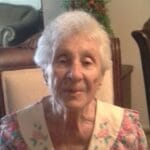
Vitya Medovaya, z"l (Moldova)
My name is Vitya Medovaya, maiden name Guberman. I lived with my parents, Esfir and Leonid Guberman, and my younger brother Yuriy in Tiraspol, the Republic of Moldova when the war began.
In the first days of the war, my father was called up to serve in the Red Army and was sent to the front. My mother decided to take my brother and me to live with relatives in Odessa, Ukraine, but when we arrived there we found that our relatives had already evacuated deep inside Russia. With difficulty, we took a train from Odessa to my aunt’s home in Voroshilovgrad, but we didn’t stay there long.[1] When the fascists began bombing Voroshilovgrad several times a day, my mother and her sister, who had three children, decided that we had to evacuate.
The trip was not easy. We were in boxcars overloaded with people. We sat so close to one another that we couldn’t get up, not even to go to the bathroom. My legs were so swollen that I couldn’t move them. There was nothing to eat at all. I was 12 years old at the time.
There is one memory of the trip I can never forget. Our train had stopped at a small station somewhere on the way to Siberia, and we could see a woman running toward us with a loaf of bread in her hands to give to us. As she threw the bread to us, a train headed in the opposite direction passed by, killing her on the tracks. We all sat and looked at that bread, but nobody touched it. Nobody. We were all very hungry, but we took this as some sort of a sign. It was horrific, but it was touching as well. With all her heart, that woman wanted to help us.
At one of the stations the evacuees were transferred to another train. My brother and I were in the second car when our mother had to return to the first to get our things. The train started to leave and my mother had to drop everything to get to us, leaving us with nothing warm to wear as fall in Siberia began.
We were bombed once along the way. It happened when we were on a bridge, not far from Voroshilovgrad. We opened the doors to the boxcar on both sides and looked at the flying airplanes. The train didn’t stop and we got through that without a single loss. At that point we didn’t know what was happening, so we weren’t afraid.
We reached the village of Poloye, in the Novosibirsk Region, and were placed in an apartment with a local woman. She was a kind person and gave us a room. We slept on the floor, all eight of us, cuddling with each other because it was warmer that way. When it started to get cold, the woman gave my mother some warm clothes. Mother was able to work, which meant she could buy food for us.
My brother and I didn’t go outside because we had nothing warm to wear. Our mother made very little and was weak from a lack of food, and she came down with malaria. We had no medicine. Her work included shoveling wheat indoors since she had nothing suitable to wear for outdoor work (she wore thin summer shoes). She was able to pocket some hot wheat and bring it home.[2]
We lived in Poloye for about six months without receiving a single letter from my father. We knew nothing of his fate. Somehow we found my aunt’s husband, who was living and working at a Sovkhoz in Tajikistan’s Stalinabad Region, and went to be with him.[3]Once there, my mother worked in the fields with many others, picking cotton. They also grew apricots and grapes there, and from the grapes they made raisins. Just as she’d shoveled wheat in Siberia, my mother was constantly shoveling raisins. In the meantime, I went to school. There was a dining hall at the Sovkhoz where they served barley soup and porridge once a day. I remember carrying our pot of soup and being afraid of spilling it or dropping it. That food was all we had.
Several months passed, and then one morning my father arrived at our home. He’d been able to find us through the information center at Buguruslan.[4] He was badly wounded in combat, and after he healed he was demobilized from the Red Army and sent to work at the Uralmash factory. He stayed there until the end of the war.[5]
We went back to Moldova in 1945 and stayed with relatives in Bender. My father was offered a job in Chimishliya village, and because he was a party member he was given a two-room apartment and a very good food allowance. I went to a Soviet trade school, but didn’t graduate because I became very ill with a bad cough and high fever.
We moved to Tiraspol, where I found work as a secretary in the city’s housing office. We were issued an apartment and ration cards to live in Tiraspol.[6] One day, as my girlfriends and I were going up the stairs at the city Cultural Center, we met several boys coming down the stairs. We stopped because my friends knew the guys, and that’s how I met my husband. We married in 1952.
We had a son and a daughter, Eduard and Inna, and were married almost 50 years. My husband was a cobbler until he graduated from trade school and started teaching young people how to make shoes. I worked as a secretary in various places all my life.
We arrived in Tucson on September 23, 1998.
[1] Voroshilovgrad, now Luhansk, is in eastern Ukraine.
[2] There was great risk in doing this. Soviet law called for up to 20 years in prison for theft.
[3] A Sovkhoz was a state-owned farm in the Soviet Union.
[4] The Soviets established the Central Information Office in Buguruslan during the war to track evacuees.
[5] Uralmash is The Ural Heavy Machine Building Plant. During the war the plant shifted from building blast furnaces, cranes, and mining equipment to producing tanks and other armored military equipment.
[6] In the former Soviet Union housing belonged to government.