
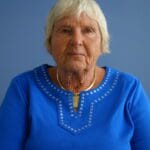
Wanda Wolosky, z"l (Poland)
Of course my mother knew about the war. It was in all the newspapers, but nobody discussed the war with me. I probably wouldn’t have understood. My father and his brother Henry decided to go to Russia. Russia was not at war with Germany at that time. One morning I woke up, and I was all alone in the apartment. I heard planes flying over the city and bombs falling. I went to the window and looked out onto the street. The street was a blanket of white down feathers that had come from pillows and blankets. A house was struck by a bomb. One house on the street was in ruins and another was on fire. I could see people in the street, running and screaming. I didn’t know what was happening. The bombing went on for a month and there was chaos in the city.
Starvation began to hit the city shortly after the first bombing raids. There were bread lines, and there were shortages of water because the Germans had bombed the water pipes. My mother was well known at the bakery across the street from our house, so she was able to get bread for a while. However, the bakery soon ran out of flour. I cried for days because I was so hungry. My mother could do nothing to ease my hunger. The German planes were flying ceaselessly. Even in the basement you could hear the sounds of the bombs hitting. If the hit was close, the basement shook. People were praying, hoping this was not their last day on earth.
The Germans marched into Warsaw in the beginning of October 1939. Trucks full of solders and motorcycles. Everything was motorized. Not a smile on their faces. The occupation had started. I was five years old. The occupiers immediately began to give decrees. They figured that all the people had lice, so their first order was for everyone to be deloused. I went with my mother to the place we were assigned to. It was in a basement of a building. They told us to undress and then sprayed us with DDT, which is a toxic substance that is no longer used because it is so hazardous.
There were new orders all the time. Jews could only have 2,000 zloty in the bank, and could only withdraw 200 zloty per week to feed their families. Another order came making it illegal for Jewish doctors to practice on Aryan patients. Teachers couldn’t teach any more. If you had a business, you had to give it up. No work, no money; true starvation had begun.
The Germans went to Jewish homes to confiscate furniture, household appliances, paintings and valuables. If you tried to resist, they would punish you. They tortured babies, and beat pregnant women and the elderly. No one was safe at home or on the streets. Jewish women were publicly humiliated, forced to undress in the street and undergo body searches. The Germans took their jewelry and fur coats, and abused them sexually. If you tried to protest, you were beaten. They searched women’s breasts and their private body parts, forcing husbands and children to watch.
There was another order from the Germans: this time they wanted all of the Jews who lived in different parts of the city to be moved into one designated section of the city, “The Ghetto,” to keep them all together. My mother was lucky: she was able to exchange our apartment with an Aryan family’s apartment in the section that was designated for the Ghetto, on Nowolipki Street. She did this quickly; she didn’t wait until the last minute. The apartment was small, with only enough space to fit three single beds side-by-side, but that was fine. My grandmother was able to get a place for her and Zeilek in the same building. She was sharing her place with others. We were happy because we were close together. We did have some time to move some of our belongings, and took whatever we could carry.
Jews were not allowed to have American dollars, but we got a letter from my father’s mother, my Grandmother Rose, who was living in the United States, saying that she was sending us money. In order to get our money, we had to leave the Ghetto. There was a tram that went through the streets of the Ghetto to the Aryan side of Warsaw. My mother and I dressed nicely, and when the tram came through the Ghetto we jumped on it. Nobody said anything to us. My mother had to wear an arm band with the Jewish star, but I didn’t have to, as the rule didn’t apply to children under the age of twelve (in Warsaw). She took it off and put it in her pocket. We went to the bank on the Aryan side, hoping all the way that we would be successful in getting the money out. When we got there, the tellers stared at us but said nothing, and gave us our money. That was a miracle. We jumped on the tram, and arrived back at the Ghetto.
The Germans decided that it wasn’t enough just to have all the Jews in one section of the city. They decided that the Jews needed to build a wall around the Ghetto, and that they had to pay for it themselves. So the Jews built the wall, which included gates. The wall was very tall, and as an extra precaution, to prevent people from trying to climb over it and get out, they put broken glass on the top of it. The gate was guarded by German soldiers, Polish police, and Jewish police. The Germans recruited Jewish people, some of whom were not very nice.
A Jewish committee was formed in the Ghetto. One of their jobs was to place as many people as possible in each room. Even so, there was not going to be enough room for half a million people in an area designated for two hundred and fifty thousand people. A Jewish policeman was assigned to live with us in our apartment. He was a good guy, and provided us with some useful information.
Starvation quickly started in the Ghetto. The daily calorie intake per person was 184, which was a slice of bread and watery soup. It was the Jewish committee that organized the soup kitchens. Children suffered the most. They walked around looking like living skeletons. Some lay on the sidewalks, looking at us with big, empty eyes. Their ragged clothes hung over their skeletal bodies. They were skin and bones.
The food situation was getting worse and worse. My mother and I became smugglers. If you got caught smuggling you were shot on the spot. There were a few different methods for leaving the Ghetto. When we heard a rumor that there was a hole in the wall or tunnel from the Ghetto to the Aryan side, we would get out that way. Another way was to go through the sewage system. Many other times we would stand by the gate and wait for a good German to let us pass. Some of the Germans had a heart, but not too many. Polish winters were extremely cold and we could wait for hours for a good German. I would shake, almost frozen, and cry from the cold and exhaustion.
Leaving the ghetto became more and more challenging to do. One day a Polish friend of ours came to see us. He was a foreman in one of the factories that had been established in the Ghetto. He said to my mother: “Blima, I am going to take your daughter with me, and tomorrow I’m going to bring her back with food.” So that day he took me with him after work. I don’t remember his name, and I don’t remember exactly where his home was. In the morning he cut a big chunk from the belly of a dead pig and wrapped it around my body under my arms. It was very tight. I walked with him back to the gates of the Ghetto. The German guard at the gate asked him for his pass. After examining the pass and seeing that all was in order, the guard returned his papers to him. Then he looked at me, put his hand on my shoulder, and said, “Are you cold my child?” I was sweating from every pore of my body because if his hand had touched just a little lower than my shoulder, he would have felt the meat that was wrapped around my body, under my coat. Instead of hearing “frierst du mein kin” (are you cold my child), I would have felt a bullet shoot through my head. The food we received lasted for quite some time.
Curfew was at 7 p.m. If you got caught on the street after curfew, you were shot. Not far from us was a prison by the name of Pawiak. The Germans used to pick up people in the street or pull them from their houses and take them to Pawiak. If you went to Pawiak you almost never came out alive. I know of only one person who ever came out alive. Her name was Irena Sandler. She was a Polish social worker who saved more than 2,500 children by smuggling them out of the Ghetto. She was eventually caught by the Germans, tortured, and was supposed to be executed, but the Polish underground bribed a German to let her escape. She died when she was in her 90s. At night, I could hear shooting come from Pawiak.
When an SS officer came into the Ghetto, he expected to have the entire sidewalk to himself. One day I was walking with my mother and there was an SS officer walking on the other side of the street. A small child on the same side of the street as this SS officer did not have enough time to get out of his way, so he picked the child up by his feet and bashed his head against the wall. He dropped the dead child’s body in the gutter. You would walk down the street and there were dead bodies lying around. You did not pay attention; it was a daily occurrence. Tomorrow it might be you.
The smell of death was everywhere. A group of undertakers would be picking up the dead bodies and throwing them on a cart. There were times when there was not enough time to pick up all the bodies, so they would lie in the streets for a day or more. Sickness took hold of the Ghetto. There was rampant malnutrition, tuberculosis, and typhus because of the lice. Life was cheap in the Ghetto; it had little value.
The Germans were ordering 6,000 people to report to the railroad station every day. They said these people were being relocated. No one knew where the trains were going. The Jewish police would round up people to be shipped out.
We hated living in the Ghetto. This was not living. So one day when we left the ghetto, my mother said we were not going back. We took absolutely nothing with us. All we had were the clothes on our backs. We slept for a few days under the steps of buildings and in basements. One day while we were walking we saw the woman from our old apartment building. This woman hated Jews and us. At one time my mother gave her a loaf of bread. That loaf of bread changed her around. My mother told her we were looking for a place to stay. There was a small building in the cemetery where she was working. She took us there and stayed with us during the day for a few weeks, bringing food and sharing it with us. We couldn’t use the stove for heat at night and it was freezing cold. The smoke would have given away the fact that somebody was staying in the cemetery at night. We could only have a fire during daylight hours. After some time my mother found another place for us, which happened to be very close to the Ghetto.
It was April 1943 when the fighting in the Ghetto started. Inside the Ghetto, young people decided that if they were going to die, they would rather die fighting than go like sheep. They bought some guns from the Polish underground, and were able to obtain some uniforms from a factory inside the Ghetto where German uniforms were made. There was a rumor that some of the young people who spoke German would disguise themselves in German uniforms. They would point out a building to the Germans and tell them that there were Jews hiding there. The Germans would go to the building, and the Jews would ambush them and take their guns. The Germans sent tanks to the Ghetto and then they went from house to house, capturing and killing everybody. At night we could see from where we were staying that the sky over the Ghetto was all red. The Ghetto was burning.
The fighting lasted for one month and then the Ghetto no longer existed. The Germans gave another order that if a Jew was found hiding in any of the buildings, everyone would get shot. We left and started looking for yet another place to hide.
Note: Wanda survived in hiding until 1945, when the Russians liberated Poland. She and her mother were able to leave Poland for Israel in 1950, where Wanda took the Hebrew name Tova, which means “good”. She served in the Israeli Army until 1954, and in 1957 she left Israel, eventually making her way to the United States. She married Gerry in 1958, and after their children were older the family moved back to Israel. They returned to the United States a few years later. When Gerry and Wanda retired, they moved to Green Valley, Arizona.