
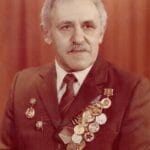
Yakov Makaron, z"l (Ukraine)
I was born on February 2, 1923, in Zhitomir, Ukraine. My father worked as an accountant at a brewery before the war, and my mother took care of the home. In 1930, my sister Lilia was born. I remember that my father had four brothers and my mother had five sisters. I attended the Twentieth Ukrainian School, from which I graduated in 1941 before the war. Given that I was not at the draft age of nineteen at the beginning of the war, I did not serve in the army until later.
I remember that on June 22, 1941, minister of foreign affairs Molotov proclaimed over the radio the treacherous invasion of Russia by the Germans and the bombing of several cities, including Zhitomir. In reality, our city was not hit by a single bomb; the bombing occurred in an aviation town, Skomorohi, now known as Ozernoye, 12 kilometers from Zhitomir. The early days of the war brought refugees who told of horrors the Germans committed during their occupation. People were considering evacuating. One of my maternal aunt’s husbands fought in World War I, and assured us that the Germans were respectable people and should not be feared. Therefore, four of my mother’s sisters stayed in Zhitomir with their families, and were killed. My parents and sister also stayed and died. But I decided to flee. My parents did not fight this, and, if I remember correctly, my mother even cooked me a chicken for the road.
I fled the city on July 6, 1941, before the Germans entered the city two days later. We departed from commercial rail platforms, heading east, and the trains stopped often and became filled with refugees. I had the chance to inquire at local military enlistment offices about the possibility of joining the army. I was denied, however, because I was not yet nineteen years old and didn’t have the required residence permit. I only carried my passport and a certificate proving that I was of age.
I ate at special places arranged for evacuees at large stations. I didn’t want to go to central Asia, so I stopped at Chkalov, now Orenburg, and registered as an evacuee. I was sent to a far off region of the steppe called Grachevskiy, and then to a collective farm where I worked as a tally clerk and gas station attendant in a tractor crew. For the rest of that summer and into the fall I lived in a tent and later in an apartment.
I enlisted in the army at the military registration and enlistment office there. Since I wasn’t clothed properly, I was given quilted pants, a jersey, and valenki (felt boots). I went to the regional center that provided universal education during the winter, joined the army on March 31, 1942, and attended commandeering courses in Sorochinsk, located in the Orenburg region.
After receiving approval from the credentials committee, I was sent to attend barrage balloon courses. After a week I was transferred to the radio faculty to study how to use the “Pauzo” apparatus, which controlled anti-aircraft artillery fire. Before I finished my studies, Moscow ordered the courses to be held at the Sorochinsk anti-aircraft machine-gun school, and I began studying large-caliber machine guns. I graduated from the academy in the spring of 1943.
Academy alumni were commissioned as lieutenants and sent to Moscow in boots with leg wrappings. I was selected to command large-caliber machine-gun platoon 1370, regiment 272, Yasskoy order of Kutuzov second degree anti-aircraft artillery division, the unit I was in for the duration of the war. Our division fought at numerous fronts and celebrated victory on May 11, 1945, on the border of Czechoslovakia and Austria. I was shell-shocked and awarded the Red Star, as well as a medal for military merit.
After the war, our division was transferred to Rahny Lesovyie Vinnitskiy region. From there, I went to Zhitomir for a short period of time to find out what happened to my relatives. A surgeon named Gorbachesky lived near our house, who’d been there during the occupation and survived. After the war he worked in a local hospital and was awarded as a “Hero of Socialist Labor”; the hospital was also named after him. But neither he, nor his wife, would tell me the fate of my parents and sister. All I could later find out was that Jewish people were told they were to be transported to a safe location, but instead were seated in cars that served as mobile gas chambers and driven to an isolated area, where six huge graves were already prepared. There’s a sign now at that location that reads: “Here, Soviet citizens have been buried,” and can be seen above each of the burial places without any factual mention that the people buried there are actually Jewish.
I left the army and returned to Zhitomir in July 1946, where I lived in the house that had belonged to my parents. The city’s party committee, which I joined after the war, selected me to be regional administrator of the People’s Commissariat for Internal Affairs.[2] Following a lengthy background check I was accepted as the operations assistant in the local police administration in January 1948. Then in 1954 a large staff reduction occurred, and I took charge of the second local police station in Zhitomir. I served in the police department for twenty seven years. During the last ten years, I worked as the deputy of the Zhitomir department of internal affairs.
I retired at 51 as a lieutenant-colonel in May 1974. Two months after retirement, I began working at a local domestic radio-electric appliances repair shop, where I stayed for twenty seven years, first as dispatcher, then as engineer of the technical department, and lastly as legal adviser. I quit in June 2001, when I was 78, because I was about to immigrate to America.
Riva Portnaya, who became my wife, worked on the railway. During the war, she evacuated with her parents to Chelyabinsk. She joined the Red Army after finishing military courses, and became a radio operator on the fourth Ukrainian front. Riva actually ran across her brother in Bulgaria during the war, whose troops happened to be there at the time. Her other brother worked as a train engineer and died during a German bombing. At the end of the war, Riva demobilized and returned to her railway work in Zhitomir. We dated for approximately a year and married in 1947, without a marriage ceremony. After we registered our marriage, we simply had lunch together with her parents.
We have two sons. Our older son Boris lives in Izhevsk, Russia. He has a son, who now lives in New York. Our second son, Alexander, worked in a factory in the Soviet Union, but lost his job after the country collapsed. Many plants were shut down, and he had to leave for America. Alexander now lives and works in Tucson, Arizona.
My wife became ill with Alzheimer’s disease, and it became dangerous to leave her at home alone. She was not aware of her actions and needed consistent care. I had to decide whether to move to Izhevsk or to America. My brother-in-law was in Boston and suggested we come here, which we did. My wife Riva died here on August 15, 2005.
Regarding Judaism, I consider myself an internationalist: everyone was equal at school, the army was international, and I did not experience anti-Semitism in the police department. I realized later, however, that anti-Semitism and quotas for Jewish persons did exist at school and at work. When my younger son applied to Moscow Physics-Technical Institute, he received great scores on the mathematics examination yet failed the second physics entrance exam, despite the fact that he’d correctly answered all the questions. Afterwards, they asked him supplemental questions such as “Why do women like to wear red shirts?” Naturally, he did not have an answer, and the admission committee members agreed that he shouldn’t pass the physics exam. A similar incident happened at a different college. I put on my military uniform to go see the college director, and specifically told him I wanted to see all of my son’s entrance exams. After that, they admitted my son to the school.
I am thankful to the United Stated for the respectful and cordial attitude toward people. But, simultaneously, I experience nostalgia for my homeland. My friends are there; every corner is dear. I empathize with the people that suffer there.